
Tag: Alice in Wonderland

  • The most important question illustrators need to answer

    The most important question illustrators need to answer

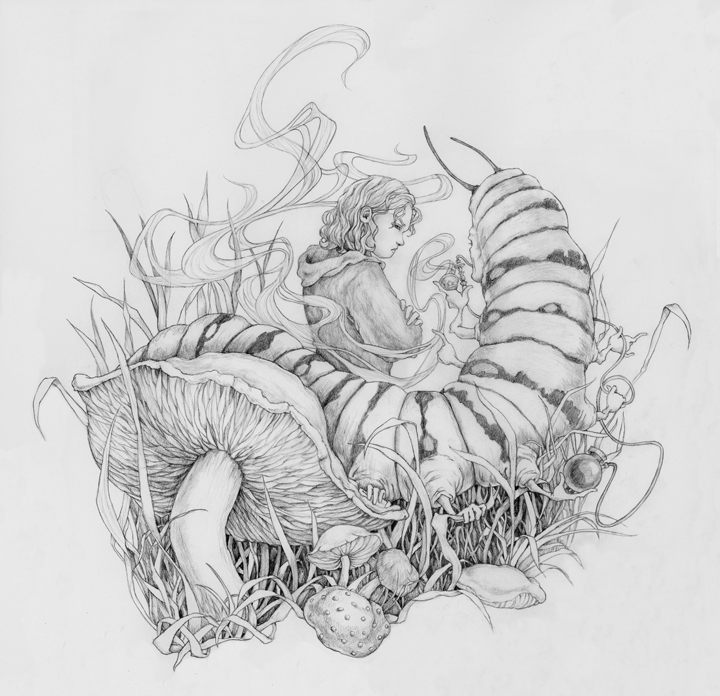
    My fascination with Alice continues, this time in her encounter with the caterpillar. He asks her the famous question, “Who are you?” I believe this question is the very heart of Lewis Carroll‘s brilliance. It is his confrontation with Alice’s escapism, as if holding up a mirror to his own character. (Is it a coincidence that the second volume is entitled “Through the Looking Glass and What Alice Found There”?) An interrogative dialogue ensues, leaving Alice flustered, unable to explain herself. Fed up, she tries to leave, embracing escapism again. The caterpillar bids her to return, this time with a command, “Keep you temper.” We don’t blame her for loosing her temper, we identify with Alice. It isn’t easy and is often unpleasant to examine what lies in the mirror.
    Alice and the caterpillar, Alice Ratterree
    “Keep Your Temper” – Alice’s Adventures in Wonderland, Lewis Carroll

    When we were children, people asked us, “What do you want to be when you grow up?” When we meet someone for the first time, inevitably the question arises, “What do you do?” When we look to higher education, we must ponder what interests us, what talent we harbor, what we want to study. The pattern here? “What,” “What,” and still more “What”… “What?” is a fine and necessary question to consider and define, but it’s the “Who are you?” questions that need our real time and efforts as illustrators. I myself will always be going back to this question, digging for the answers, which needs a life’s work of tending to grow and refine. And in the meantime, I also try to keep my temper.

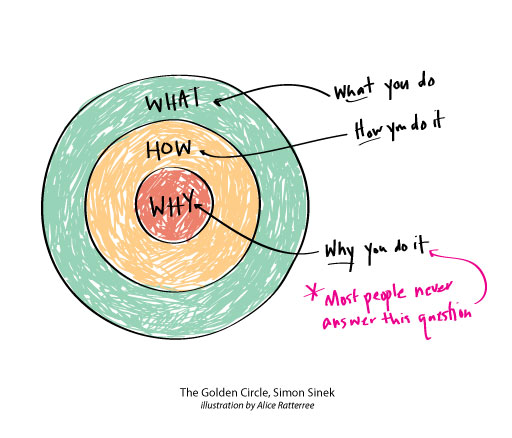
    My universe aligned again this week when I attended the annual F.I.R.E. Session hosted by Brains on Fire. The opening talk was given by Jackie Huba, author of the upcoming book, Monster Loyalty: How Lady Gaga Turns Followers into Fanatics. Bet you didn’t think you’d find anything out there that went from Alice in Wonderland to Lady Gaga, but bear with me. I must admit, I’m not a follower of Lady Gaga, and no fanatic, so I can’t officially call myself a “Little Monster” but I do find brilliance in her ability to connect with her fan base, which is what I learned from Jackie this week. And it is in this quest to connect with her fan base, which is value-driven, that Lady Gaga has defined a core group of identity questions, thus enabling her success as an artist. Jackie revealed to us a concept created by Simon Sinek called the Golden Circle that succinctly sums it up:
    GoldenCircle_diagram

    So here are the three questions, that if well-defined, embody a successful product: What do you do? How do you do it? Why do you do it? Seems simple enough, right? Start trying to really answer these questions about yourself. The “what” is the easy part. It’s your product, plain and simple. So what is Lay Gaga’s “what”? Her “what” is basic: she writes and performs catchy pop songs. But is that really the sum of it all that “Little Monsters” would say when asked “Who is Lady Gaga?” There are plenty of singer/songwriters out there writing and performing catchy pop songs. So what makes her different? The answer lies deeper. Next question: How does Lady Gaga do it? This is what puts her at the top of talking trends today in social media circles. She lives her life as performance art. Think Andy Warhol. Do only the images of his artwork come to mind? No, it is his entire identity. His life style. Go further and you get to the “Why?” Lady Gaga has a platform based on a clear set of values. She is passionate about transforming culture to embrace differences and celebrate individuality, and has created the Born This Way Foundation to promote this value system.

    So let’s apply this to illustration work:
    WHAT do you do? Illustrate (and for some of us, write also) books for children and youth. This question does not require much introspection and is not highly individualized.
    HOW do you do it? This can be defined as your style, ie: the treatment of characters and composition, and the choices that are made in the process. Do you employ realism or are your illustrations whimsical, comic or graphic? Maybe somewhere in between? Are the materials you use an integral part of this unique style? How does this flow into your life style and image? Does social media play a role?
    WHY do you do it? This is where it gets purely individual. It is the core, a set of clear values that you harbor and is linked to a larger message you want to impress upon our viewer. Think back to what drove you to pick up that pencil, pen, brush, in the first place. So reflect carefully on the reason you wish to connect with children today and what you want them to see in your work. Because in the end, that is what it is all about. Connecting with our audience – children.

    Clear definitive separation of “What” “How” and “Why” is the key. And “Why” is the engine that must fuel and drive the “How” and the “What.” So why do so many of us only stop and focus on “What?” It seems to be a little backwards, right? We start with “What”, then move to “How” then try to fit “Why” in there somewhere. Maybe if we start with “Why” and work outward, then we will finally be able to face that caterpillar when he asks “Who are you?”
  • SCBWI Carolinas Pen & Palette Interview

    SCBWI Carolinas Pen & Palette Interview

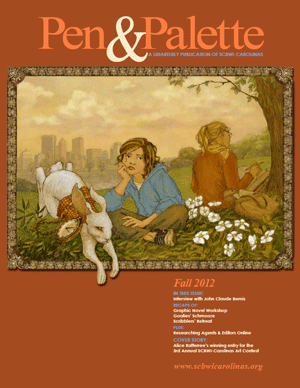
    Here are some excepts from my interview in Pen & Palette as SCBWI Carolinas First Place winner for the 2012 Art Contest. Congratulations to Brenda Gilliam and Jennifer Noel Bower who were also recognized for their work.

    PenandPaletteFall2012Rather than focus on a single illustrator, this issue showcases the top three winners of the 3rdAnnual SCBWI Carolinas Art Contest. Alice Ratterree’s first-place entry is featured as this issue’s cover image. Illustrators participating in the contest were asked to render their interpretations of the opening lines of Lewis Carroll’s classic, Alice ’s Adventures in Wonderland :

    Alice was beginning to get very tired of sitting by her sister on the bank, and of having nothing to do. Once or twice she peeped into the book her sister was reading, but it had no pictures or conversations in it, “and what is the use of a book,” thought Alice, “without pictures or conversations?” So she was considering in her own mind (as well as she could, for the day made her feel very sleepy and stupid), whether the pleasure of making a daisy-chain would be worth the trouble of getting up and picking daisies, when suddenly a White Rabbit with pink eyes ran close by her.

    What about this year’s prompt spoke to you? What aspect of the story drew you in?

    ALICE RATTERREE:  I am always inspired by the classics, and particularly have identified with Alice. Maybe it’s the name thing—as silly as it sounds—but as a child I really did believe this was a story written just for (and about) me! I had a healthy dose of Lewis Carroll growing up (being the child of a schoolteacher who devoted an entire unit to the Alice books and Carroll’s use of political satire and mathematics), so naturally, when faced with the prompt, I already felt at home with the text.

    What drew me into this challenge was the lushness of the introduction. In only a few sentences, we are given a vast amount of information on the lazy setting of the afternoon and Alice’s attitude about it, then immediately propelled into the story. The task of portraying Alice’s restlessness and boredom juxtaposed with the action of the rabbit was, in my mind, the foundation for the composition.

    How did you decide what your approach would be (style, composition, medium)?

    ALICE RATTERREE:  So many artists have tackled this work, and we’re all standing in the shadow of the giant, John Tenniel. I wanted to offer something fresh and surprising, but honor the timelessness of the story. My goal was to utilize a classic illustration drafting technique inside a modern era setting, costuming Alice in hoodie and jeans (complete with the pre-adolescent pout) and portraying her sister as the consummate graduate student (perhaps herself not entirely thrilled with having her sister tag along due to whatever multitude of reasons this circumstance could be translated to today) and involved in her many textbooks “without  pictures.”

    The process and composition sort of evolved, as opposed to being a conscious decision. The most challenging aspect of the prompt was that each character is seemingly independent and unconnected with each other, involved in their own spheres of activity (or inactivity), and while we know that Alice eventually sees the rabbit and reacts by following him down the hole out of curiosity, we, the readers, are introduced to him (I believe) the moment right before she actually sees him…or at least that split second between a double take.

    It is this rabbit figure that grabbed me most because Carroll elevates him by capitalizing the “W” and the “R” and I couldn’t shake the feeling that this character carried an omnipotent quality. He’s the one who takes us by surprise out of that lazy afternoon by the riverbank, and as a reader, I am as much surprised by the appearance of him as Alice. Therefore I wanted to make him not only the one active figure in the composition, but to also be the connection between the viewer and the illustration, looking straight at us (inspired by Lewis’ poignant mention of the pink eyes), and literally emerging from that still place.

    With all of that floating around in my head, and without structure, I started drafting each figure independently, and the whole process started to work like a pop-up book. Using Photoshop, I manipulated each figure like paper dolls in three spatial planes of existence – first the rabbit, then Alice, and then her sister and landscape. So once the final composition came together, I completed the piece by painting in Photoshop.

    How did the exercise of completing the contest entry, and the feedback from the contest judge, benefit your work?

    ALICE RATTERREE:  The main lesson I learned through the exercise was commitment and conviction. Somewhere in the process of trying to connect these three independent characters, I started traveling down the road of self-doubt and started over completely with a few new drafts. In the end, I came back to my original concept, determined to commit to it and attempt to make it work.

    The feedback was very helpful because the viewer addressed this accountability for the two choices I had made that deviated somewhat from traditional expectation: 1) Alice in somewhat of a visually secondary role to the rabbit, and 2) the lack of connection between the rabbit and Alice. This observation has helped me realize that when making choices, particularly those that may be unconventional and unexpected, I need to work on making them clear and intentional. Commitment and conviction.