
Tag: Awards

  • Tomie dePaola Award: Illustration Using Silhouette

    Tomie dePaola Award: Illustration Using Silhouette

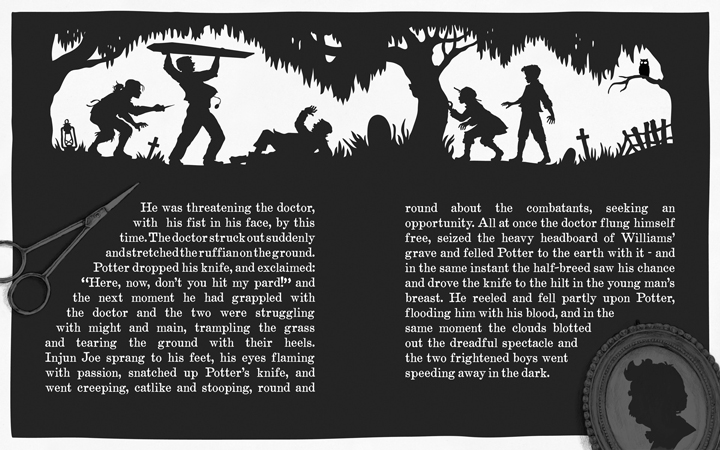
    My entry for the 2013 SCBWI Tomie dePaola Award.

    Papercutting is an art form that has been practiced for centuries in many different cultures throughout the world. Being a bit biased, I am particularly drawn to the Southern American heritage of artform of silhouette. A few months ago we discovered this Carew Rice paper cut:
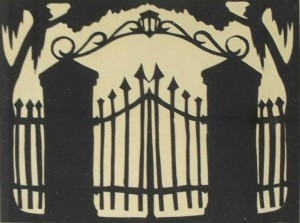
    Charleston Gate • Carew Rice • 1933
    Charleston Gate • Carew Rice • 1933

    Rice, a South Carolina native who has been hailed as “America’s Greatest Silhouettist” by the poet Carl Sandberg, was extremely prolific with the medium and brought sophistication and prominence to the technique. The practice derived its name from Eteinne de Silhouette, the French finance minister under Louis XV who imposed high taxes. Since paper-cuts were a more economical way of obtaining a portrait at the time, the business thrived and became a symbol of the economic times, thus forever linking the same “silhouette” with the practice. Silhouettes arrived in America and quickly became the rage in the 18th and 19th century until photography took the forefront. It is now revered for its aesthetic charm and elegant simplicity.

    SCBWI‘s annual Tomie dePaola Award is given annually to an SCBWI member illustrator that demonstrates potential and is chosen by Tomie dePaola. The award grants tuition, transportation and accommodations to the New York Winter Conference held in Manhattan, and the winning piece is featured at the annual winter conference in New York.

    The guidelines for this year’s award were to pick any passage from any one of the following novels: The Adventures of Tom Sawyer (Twain), Little Women (Alcott), The Yearling (Rawlings) The artwork must be in black and white, including half-tones.

    This inspired me to pay homage to the southern heritage of paper cutting and the silhouette artform with Mark Twain‘s classic, The Adventures of Tom Sawyer. My intention was to create two narratives. One being a silhouette depiction of the scene, which takes place in chapter 9, and then another on top of that, which is a commentary on the practice of paper cutting depicted by the rendering of the scissors and the framed silhouette portrait of the author. I chose to lay the text in white on top of the black to further intensify the horrific action the boys are witnessing in the graveyard.
    Alice_Ratterree

    Tomie dePaola, reknowned for his books for children, is an illustrator who has been published for over 40 years and has written and/or illustrated nearly 250 books with over 15 million copies of his books sold worldwide. His work and achievements have been recognized with the Smithson Medal from the Smithsonian Institution, the Kerlan Award from the University of Minnesota for his “singular attainment in children’s literature,” and the Regina Medal from the Catholic Library Association. He was also the United States nominee in 1990 for the Hans Christian Andersen Award in illustration. The American Library Association has honored him with a Caldecott Honor Book, a Newbery Honor Book, and the 2011 Laura Ingalls Wilder Award for his “substantial and lasting contribution to literature for children.”

    Tomie financially provided the award until 2011 when SCBWI assumed it in recognition of Tomie’s outstanding contribution to SCBWI and to the member illustrators in particular. He has been a member of the Board of Advisors, aided in changing the name of the original organization to include illustrators, founded the Illustrator’s Committee of the SCBWI board, and taught the first master class at an SCBWI conference.
  • SCBWI Carolinas Pen & Palette Interview

    SCBWI Carolinas Pen & Palette Interview

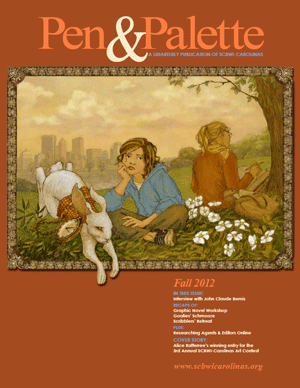
    Here are some excepts from my interview in Pen & Palette as SCBWI Carolinas First Place winner for the 2012 Art Contest. Congratulations to Brenda Gilliam and Jennifer Noel Bower who were also recognized for their work.

    PenandPaletteFall2012Rather than focus on a single illustrator, this issue showcases the top three winners of the 3rdAnnual SCBWI Carolinas Art Contest. Alice Ratterree’s first-place entry is featured as this issue’s cover image. Illustrators participating in the contest were asked to render their interpretations of the opening lines of Lewis Carroll’s classic, Alice ’s Adventures in Wonderland :

    Alice was beginning to get very tired of sitting by her sister on the bank, and of having nothing to do. Once or twice she peeped into the book her sister was reading, but it had no pictures or conversations in it, “and what is the use of a book,” thought Alice, “without pictures or conversations?” So she was considering in her own mind (as well as she could, for the day made her feel very sleepy and stupid), whether the pleasure of making a daisy-chain would be worth the trouble of getting up and picking daisies, when suddenly a White Rabbit with pink eyes ran close by her.

    What about this year’s prompt spoke to you? What aspect of the story drew you in?

    ALICE RATTERREE:  I am always inspired by the classics, and particularly have identified with Alice. Maybe it’s the name thing—as silly as it sounds—but as a child I really did believe this was a story written just for (and about) me! I had a healthy dose of Lewis Carroll growing up (being the child of a schoolteacher who devoted an entire unit to the Alice books and Carroll’s use of political satire and mathematics), so naturally, when faced with the prompt, I already felt at home with the text.

    What drew me into this challenge was the lushness of the introduction. In only a few sentences, we are given a vast amount of information on the lazy setting of the afternoon and Alice’s attitude about it, then immediately propelled into the story. The task of portraying Alice’s restlessness and boredom juxtaposed with the action of the rabbit was, in my mind, the foundation for the composition.

    How did you decide what your approach would be (style, composition, medium)?

    ALICE RATTERREE:  So many artists have tackled this work, and we’re all standing in the shadow of the giant, John Tenniel. I wanted to offer something fresh and surprising, but honor the timelessness of the story. My goal was to utilize a classic illustration drafting technique inside a modern era setting, costuming Alice in hoodie and jeans (complete with the pre-adolescent pout) and portraying her sister as the consummate graduate student (perhaps herself not entirely thrilled with having her sister tag along due to whatever multitude of reasons this circumstance could be translated to today) and involved in her many textbooks “without  pictures.”

    The process and composition sort of evolved, as opposed to being a conscious decision. The most challenging aspect of the prompt was that each character is seemingly independent and unconnected with each other, involved in their own spheres of activity (or inactivity), and while we know that Alice eventually sees the rabbit and reacts by following him down the hole out of curiosity, we, the readers, are introduced to him (I believe) the moment right before she actually sees him…or at least that split second between a double take.

    It is this rabbit figure that grabbed me most because Carroll elevates him by capitalizing the “W” and the “R” and I couldn’t shake the feeling that this character carried an omnipotent quality. He’s the one who takes us by surprise out of that lazy afternoon by the riverbank, and as a reader, I am as much surprised by the appearance of him as Alice. Therefore I wanted to make him not only the one active figure in the composition, but to also be the connection between the viewer and the illustration, looking straight at us (inspired by Lewis’ poignant mention of the pink eyes), and literally emerging from that still place.

    With all of that floating around in my head, and without structure, I started drafting each figure independently, and the whole process started to work like a pop-up book. Using Photoshop, I manipulated each figure like paper dolls in three spatial planes of existence – first the rabbit, then Alice, and then her sister and landscape. So once the final composition came together, I completed the piece by painting in Photoshop.

    How did the exercise of completing the contest entry, and the feedback from the contest judge, benefit your work?

    ALICE RATTERREE:  The main lesson I learned through the exercise was commitment and conviction. Somewhere in the process of trying to connect these three independent characters, I started traveling down the road of self-doubt and started over completely with a few new drafts. In the end, I came back to my original concept, determined to commit to it and attempt to make it work.

    The feedback was very helpful because the viewer addressed this accountability for the two choices I had made that deviated somewhat from traditional expectation: 1) Alice in somewhat of a visually secondary role to the rabbit, and 2) the lack of connection between the rabbit and Alice. This observation has helped me realize that when making choices, particularly those that may be unconventional and unexpected, I need to work on making them clear and intentional. Commitment and conviction.