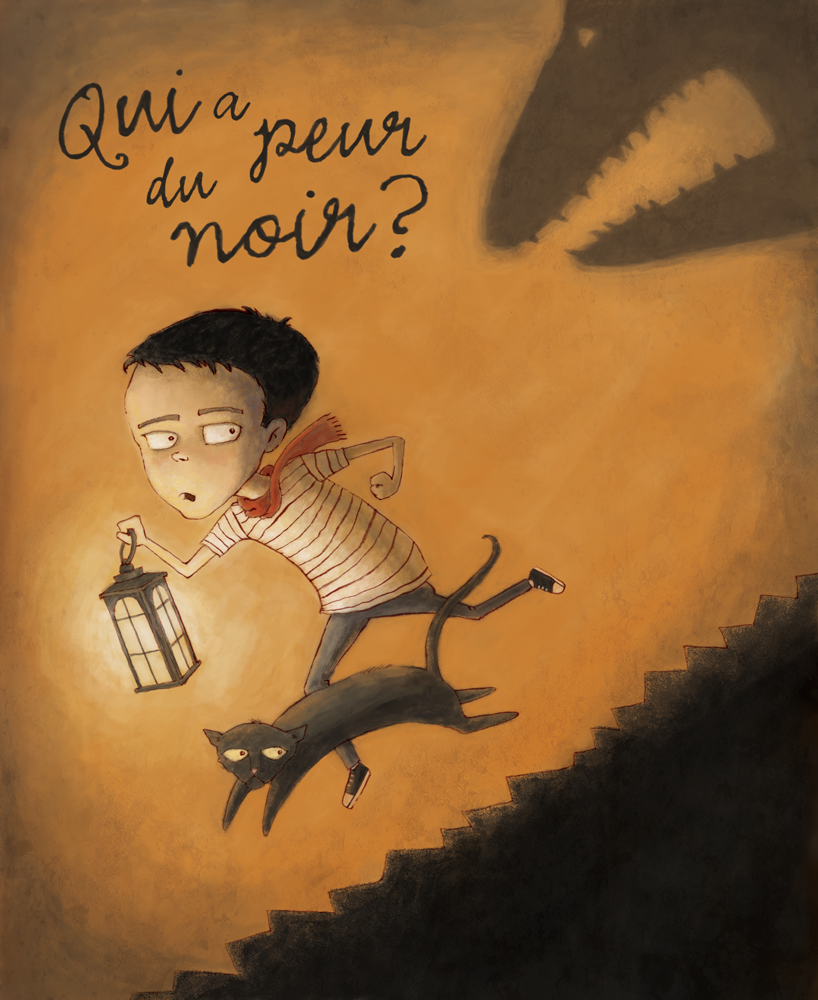
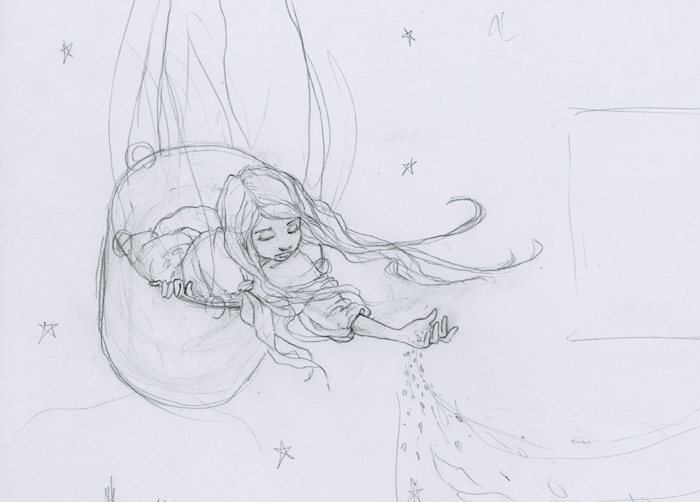
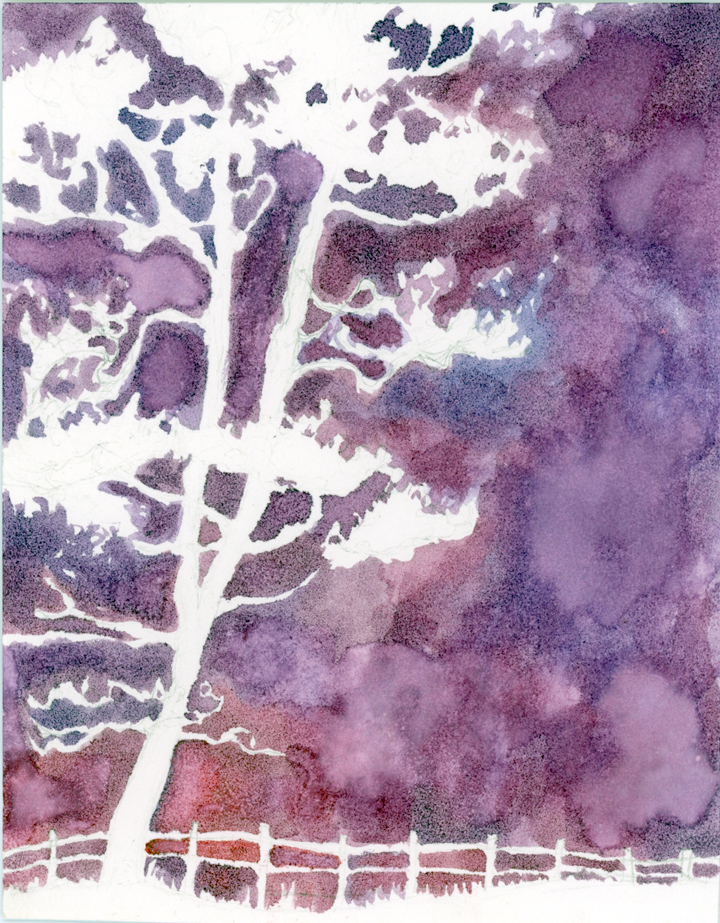
“Who’s afraid of the dark?” illustration by Alice Ratterree
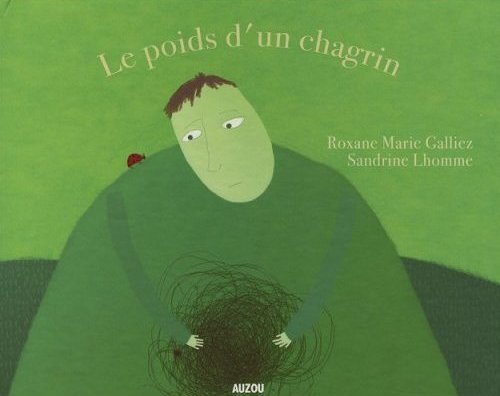
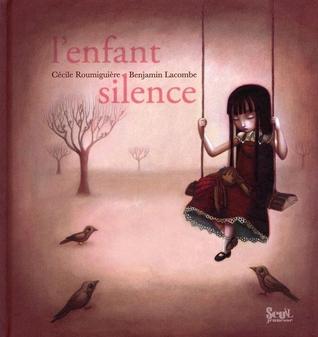
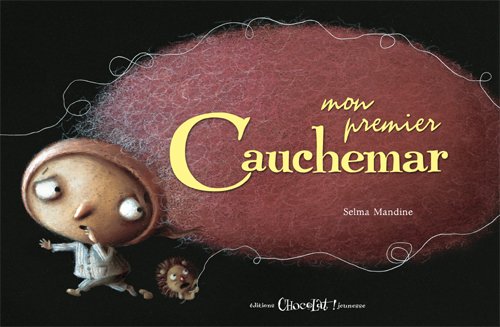
You know that 5 minute window before you actually wake up and are a bit lucid, but still kind of dreaming too? Well, this is a result of that state, the season, and perhaps also as an homage to the dark children’s books frequently produced by French publishers, which I am continuously fascinated by. Take a look at some of these titles to soothe your little one to sleep:
“The weight of grief” illustration by Roxanne Marie Galliez“The silent child” illustration by Benjamin Lacombe“My first nightmare” illustration by Mandine Selma
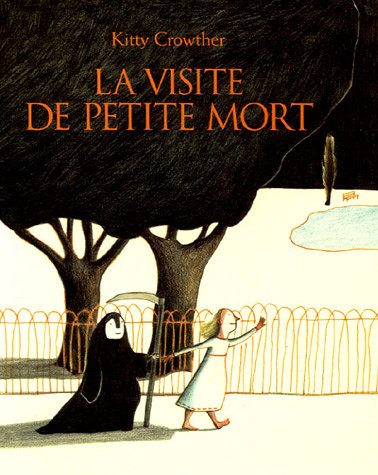
And my personal favorite,
“The visit of little death” illustration by Kitty Crowther
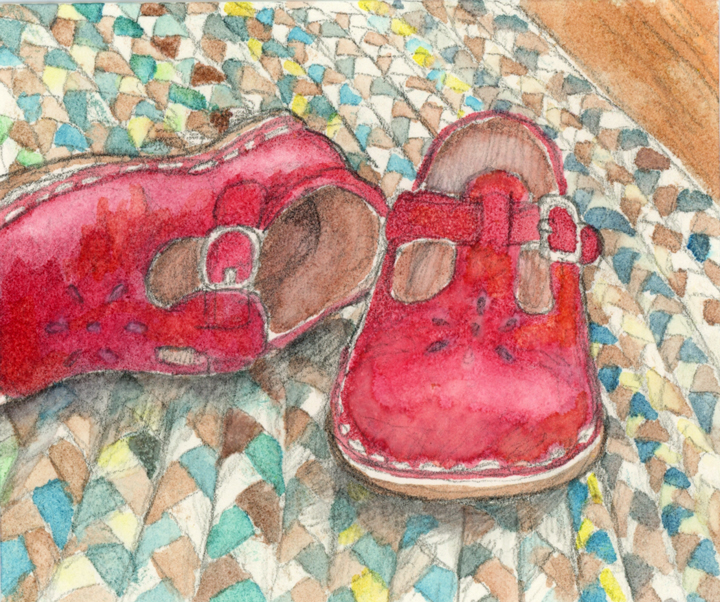
I love line work, and generally only utilize the pencil and sometimes a pen. Recently, though, I’ve been working with the push and pull of a paintbrush, and I’m very happy with the trembling energy it leaves on the paper. Here’s today’s sketch using watercolor (M. Graham) and a no. 2 Kolinsky sable. I still relied on pencil to start the sketch, then erased draft lines after painting. The sketch was drawn over a block of color I laid down a few weeks ago, when I was testing new paints (M. Graham) and saturation on hot press paper.
Daily sketch 10-07 illustration by Alice Ratterree
A blank sheet of paper can be intimidating for both writers and illustrators. Nothing else can inspire creativity and instill fear both at the same time. Even when I can “see” the finished image in my head, it doesn’t just flow out onto the paper. A writer re-writes rather than writes, and an illustrator needs visual reference, something to work from, rather than pulling a perfect image from the brain. This is a one-step process for still life or portrait work, but what about when you need a witch flying on a broom, or a beanstalk climbing into the sky? Don’t see that around every day, do you? Or do you….? The elements in every fantastical illustration are all present in every day life. We just need to find them and harness them into one frame. Here’s where Photoshop has become my number one tool of late to perform what I’ve heard referred to as “Frankenstein Reference Imagery”. By using the program to create a collage, you then have something tangible to work from.
Here are some examples:
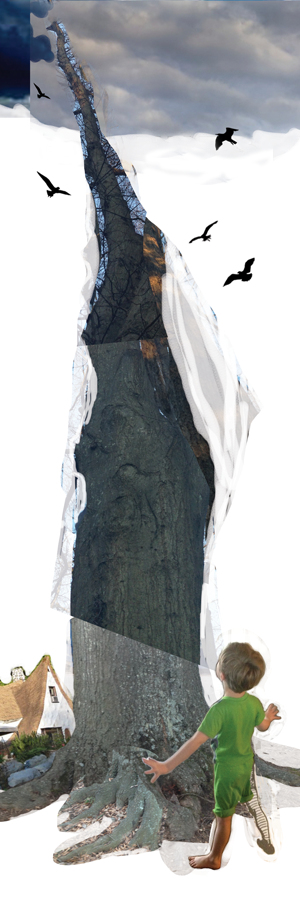
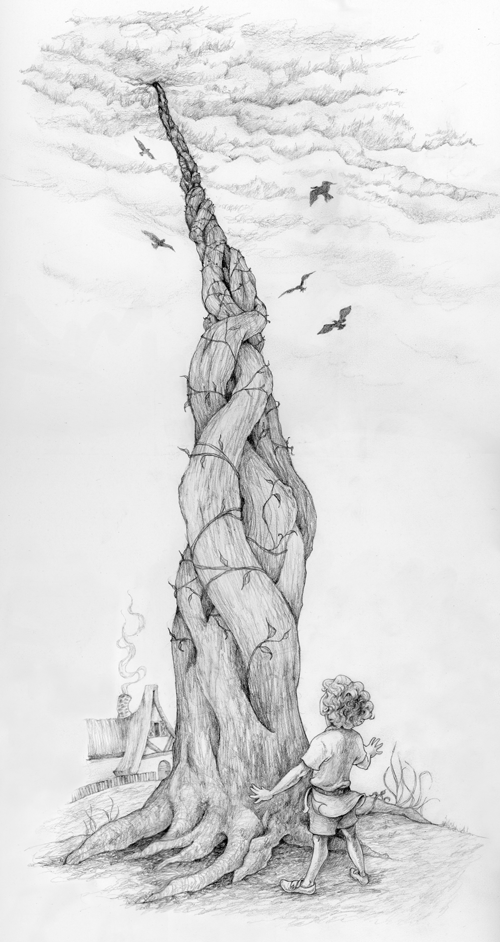
Step 1) Collage using Photoshop. I took a photo of my son in the pose I wanted. As you can see, the photo I took of him didn’t represent the angle and stance I wanted for the hind leg, so I inserted an alternate leg pose that embodied the energy I was trying to achieve. I then found some trees in our back yard that provided the roots and perspective. Then incorporated third party images for the clouds, birds, and the cottage.
“Frankenstein Reference Imagery” using collage to create visual reference
Step 2) The finished illustration. Using the collage as a starting point, I’m inspired and feel free to make changes and embellishments and make it my own.
Jack and the Beanstalk illustration by Alice Ratterree
And another example:
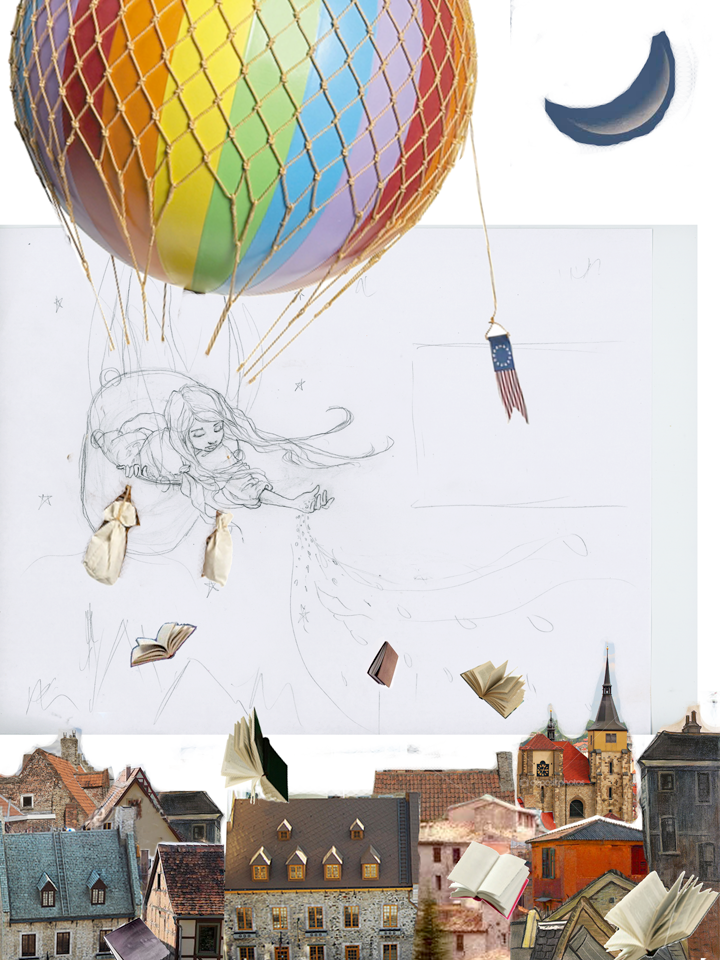
Step 1) The collage in Photoshop this time also incorporating my own sketch work:
“Frankenstein Reference Imagery” using collage to create visual reference
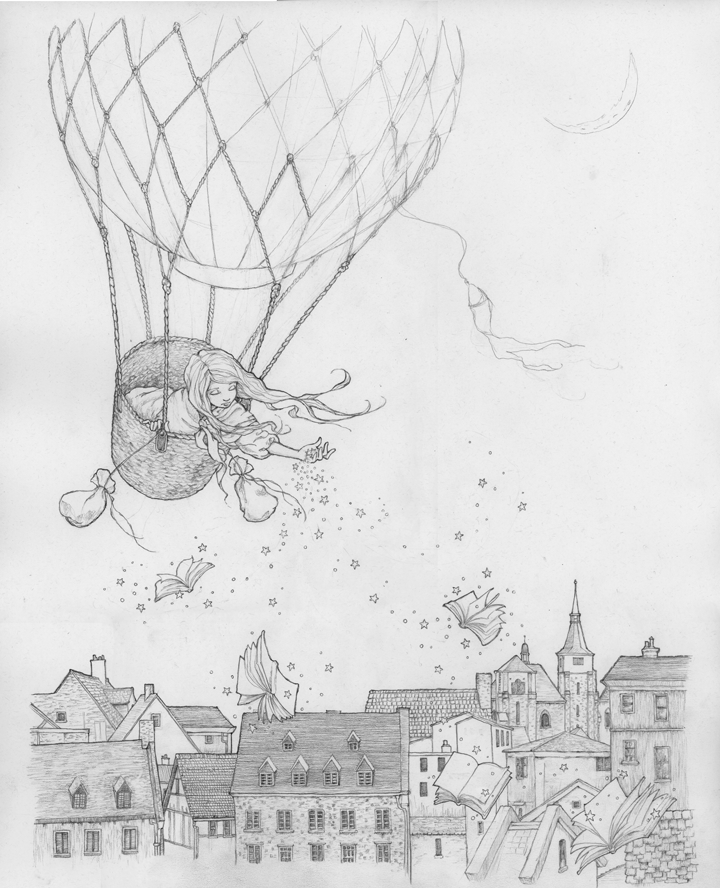
Step 2) The pencil work in progress
The Book Balloon (work in progress) illustration by Alice Ratterree
Illustrator promo of the day: Lisbeth Zwerger. Let’s get real, she needs no promo from me…just want everyone to know about her. Hands down, one of my favorites.
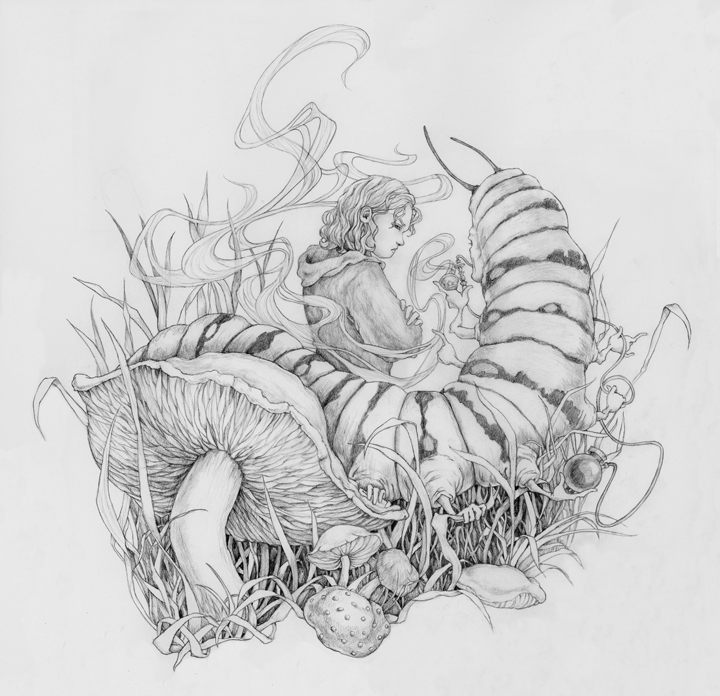
My fascination with Alice continues, this time in her encounter with the caterpillar. He asks her the famous question, “Who are you?” I believe this question is the very heart of Lewis Carroll‘s brilliance. It is his confrontation with Alice’s escapism, as if holding up a mirror to his own character. (Is it a coincidence that the second volume is entitled “Through the Looking Glass and What Alice Found There”?) An interrogative dialogue ensues, leaving Alice flustered, unable to explain herself. Fed up, she tries to leave, embracing escapism again. The caterpillar bids her to return, this time with a command, “Keep you temper.” We don’t blame her for loosing her temper, we identify with Alice. It isn’t easy and is often unpleasant to examine what lies in the mirror.
“Keep Your Temper” – Alice’s Adventures in Wonderland, Lewis Carroll
When we were children, people asked us, “What do you want to be when you grow up?” When we meet someone for the first time, inevitably the question arises, “What do you do?” When we look to higher education, we must ponder what interests us, what talent we harbor, what we want to study. The pattern here? “What,” “What,” and still more “What”… “What?” is a fine and necessary question to consider and define, but it’s the “Who are you?” questions that need our real time and efforts as illustrators. I myself will always be going back to this question, digging for the answers, which needs a life’s work of tending to grow and refine. And in the meantime, I also try to keep my temper.
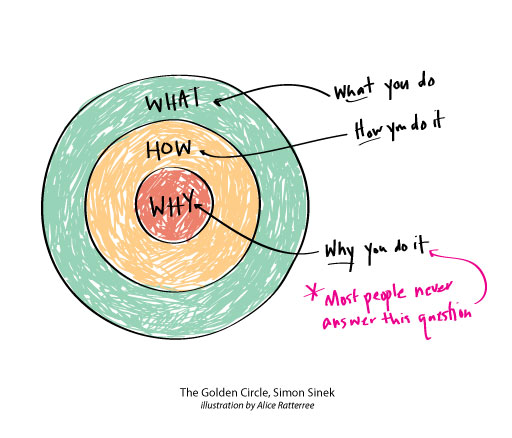
My universe aligned again this week when I attended the annual F.I.R.E. Session hosted by Brains on Fire. The opening talk was given by Jackie Huba, author of the upcoming book, Monster Loyalty: How Lady Gaga Turns Followers into Fanatics. Bet you didn’t think you’d find anything out there that went from Alice in Wonderland to Lady Gaga, but bear with me. I must admit, I’m not a follower of Lady Gaga, and no fanatic, so I can’t officially call myself a “Little Monster” but I do find brilliance in her ability to connect with her fan base, which is what I learned from Jackie this week. And it is in this quest to connect with her fan base, which is value-driven, that Lady Gaga has defined a core group of identity questions, thus enabling her success as an artist. Jackie revealed to us a concept created by Simon Sinek called the Golden Circle that succinctly sums it up:
So here are the three questions, that if well-defined, embody a successful product: What do you do? How do you do it? Why do you do it? Seems simple enough, right? Start trying to really answer these questions about yourself. The “what” is the easy part. It’s your product, plain and simple. So what is Lay Gaga’s “what”? Her “what” is basic: she writes and performs catchy pop songs. But is that really the sum of it all that “Little Monsters” would say when asked “Who is Lady Gaga?” There are plenty of singer/songwriters out there writing and performing catchy pop songs. So what makes her different? The answer lies deeper. Next question: How does Lady Gaga do it? This is what puts her at the top of talking trends today in social media circles. She lives her life as performance art. Think Andy Warhol. Do only the images of his artwork come to mind? No, it is his entire identity. His life style. Go further and you get to the “Why?” Lady Gaga has a platform based on a clear set of values. She is passionate about transforming culture to embrace differences and celebrate individuality, and has created the Born This Way Foundation to promote this value system.
So let’s apply this to illustration work:
WHAT do you do? Illustrate (and for some of us, write also) books for children and youth. This question does not require much introspection and is not highly individualized.
HOW do you do it? This can be defined as your style, ie: the treatment of characters and composition, and the choices that are made in the process. Do you employ realism or are your illustrations whimsical, comic or graphic? Maybe somewhere in between? Are the materials you use an integral part of this unique style? How does this flow into your life style and image? Does social media play a role?
WHY do you do it? This is where it gets purely individual. It is the core, a set of clear values that you harbor and is linked to a larger message you want to impress upon our viewer. Think back to what drove you to pick up that pencil, pen, brush, in the first place. So reflect carefully on the reason you wish to connect with children today and what you want them to see in your work. Because in the end, that is what it is all about. Connecting with our audience – children.
Clear definitive separation of “What” “How” and “Why” is the key. And “Why” is the engine that must fuel and drive the “How” and the “What.” So why do so many of us only stop and focus on “What?” It seems to be a little backwards, right? We start with “What”, then move to “How” then try to fit “Why” in there somewhere. Maybe if we start with “Why” and work outward, then we will finally be able to face that caterpillar when he asks “Who are you?”
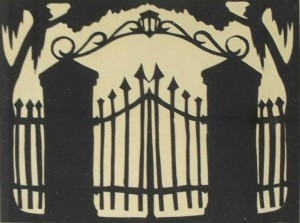
Papercutting is an art form that has been practiced for centuries in many different cultures throughout the world. Being a bit biased, I am particularly drawn to the Southern American heritage of artform of silhouette. A few months ago we discovered this Carew Rice paper cut:
Charleston Gate • Carew Rice • 1933
Rice, a South Carolina native who has been hailed as “America’s Greatest Silhouettist” by the poet Carl Sandberg, was extremely prolific with the medium and brought sophistication and prominence to the technique. The practice derived its name from Eteinne de Silhouette, the French finance minister under Louis XV who imposed high taxes. Since paper-cuts were a more economical way of obtaining a portrait at the time, the business thrived and became a symbol of the economic times, thus forever linking the same “silhouette” with the practice. Silhouettes arrived in America and quickly became the rage in the 18th and 19th century until photography took the forefront. It is now revered for its aesthetic charm and elegant simplicity.
SCBWI‘s annual Tomie dePaola Award is given annually to an SCBWI member illustrator that demonstrates potential and is chosen by Tomie dePaola. The award grants tuition, transportation and accommodations to the New York Winter Conference held in Manhattan, and the winning piece is featured at the annual winter conference in New York.
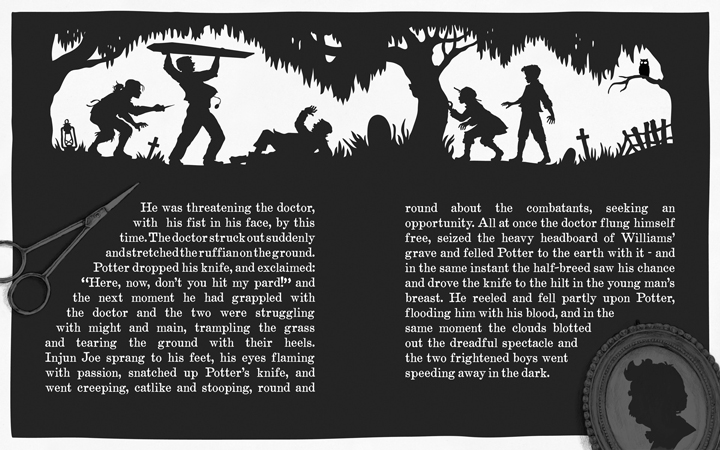
The guidelines for this year’s award were to pick any passage from any one of the following novels: The Adventures of Tom Sawyer (Twain), Little Women (Alcott), The Yearling (Rawlings) The artwork must be in black and white, including half-tones.
This inspired me to pay homage to the southern heritage of paper cutting and the silhouette artform with Mark Twain‘s classic, The Adventures of Tom Sawyer. My intention was to create two narratives. One being a silhouette depiction of the scene, which takes place in chapter 9, and then another on top of that, which is a commentary on the practice of paper cutting depicted by the rendering of the scissors and the framed silhouette portrait of the author. I chose to lay the text in white on top of the black to further intensify the horrific action the boys are witnessing in the graveyard.
Tomie dePaola, reknowned for his books for children, is an illustrator who has been published for over 40 years and has written and/or illustrated nearly 250 books with over 15 million copies of his books sold worldwide. His work and achievements have been recognized with the Smithson Medal from the Smithsonian Institution, the Kerlan Award from the University of Minnesota for his “singular attainment in children’s literature,” and the Regina Medal from the Catholic Library Association. He was also the United States nominee in 1990 for the Hans Christian Andersen Award in illustration. The American Library Association has honored him with a Caldecott Honor Book, a Newbery Honor Book, and the 2011 Laura Ingalls Wilder Award for his “substantial and lasting contribution to literature for children.”
Tomie financially provided the award until 2011 when SCBWI assumed it in recognition of Tomie’s outstanding contribution to SCBWI and to the member illustrators in particular. He has been a member of the Board of Advisors, aided in changing the name of the original organization to include illustrators, founded the Illustrator’s Committee of the SCBWI board, and taught the first master class at an SCBWI conference.
This past weekend, SCBWI Carolinas celebrated their 20th annual conference in Charlotte, NC. I love returning to the well. Inspiring keynotes and energizing breakouts filled our time for three whole days! Illustrators arrived early on Friday for an intensive session with the charming illustrator Priscilla Burris. We were given an assignment ahead of time which was:
Characters Page: Create and develop two characters. Name them.
Main Image: Create and Color Finish an image involving both characters, interacting. (Either one page or 2-pg spread)
Before Image: Create and Sketch an image that shows what happened before the Main Image part of the story.
After Image: Create and Sketch an image that shows what happens after the Main Image part of the story.
Daunting to say the least. No restrictions, not even dimensions. Wide open. I have to admit, when I received this challenge, I was rather disappointed, and frankly had a bad attitude. I wanted something to work with. Please oh please don’t leave me alone in the dark recesses of my shallow creativity to make something completely original! I felt like I was suddenly being asked to write, and I wanted to illustrate! Sadly, I realized that I’ve been relying on someone else’s work to propel me into my work. How was I going to start with a completely blank canvas?
The answer was in creating boundaries. I’ve heard it said that if children are playing in a large field with no fence, they will gather together in a tight radius near the middle and not venture out very far from each other, playing within a very limited space. If, however they are provided a fenced in perimeter, they will utilize all the space for play. I read that Dr. Seuss had only a 225 word list with which to work from in writing Cat in the Hat. Boundaries propel us into creative thinking by forcing us to solve problems. Last year at the convention, writer John Bemis left us with a most inspiring keynote that provided some tools to work with when we are faced with creative blocks. We were all asked to write 20 words, then step back and look at them. What did they say? Where was the common thread? Is there any imagery that comes to mind? Next he shared with us a game that included asking a question, then find a picture (from a magazine or a book). The last step is to connect your question with the image you found. How does the image you found answer your question?
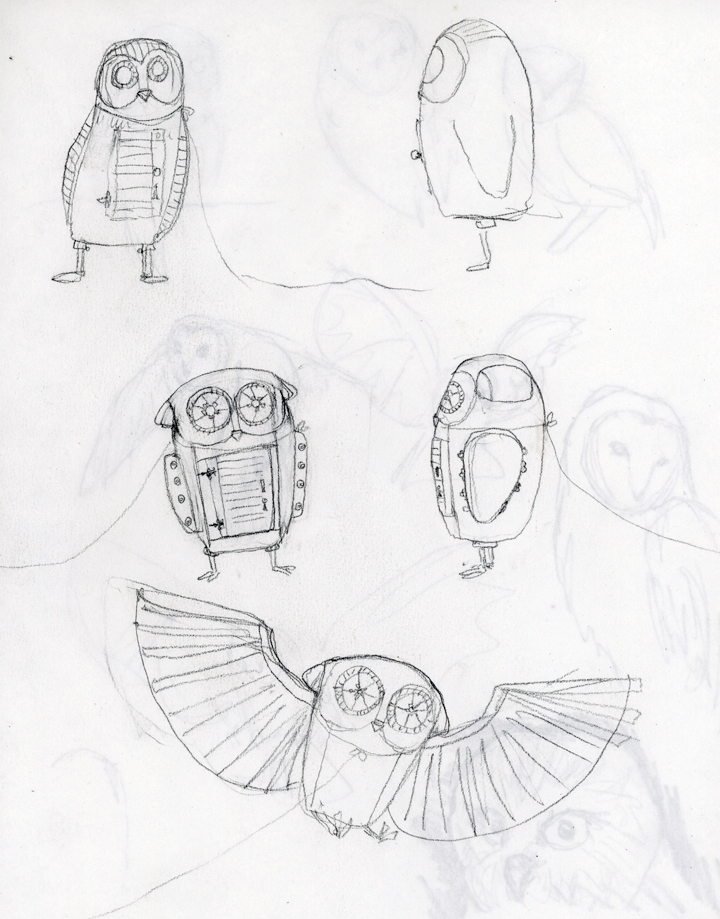
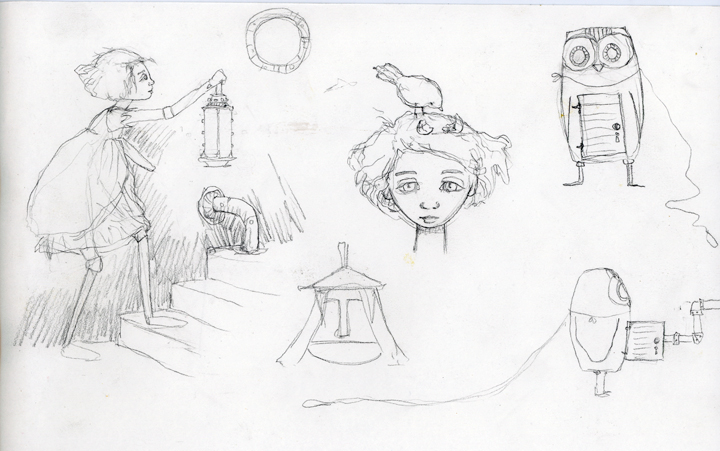
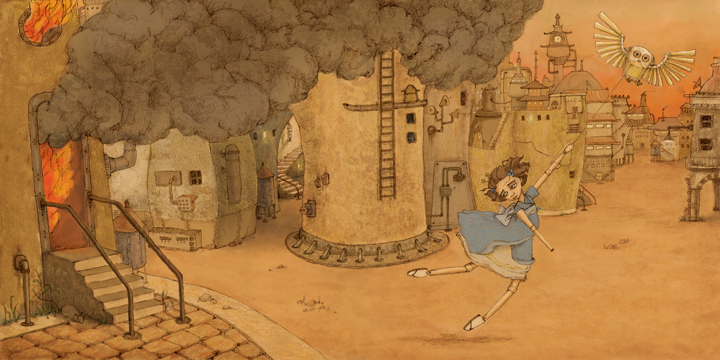
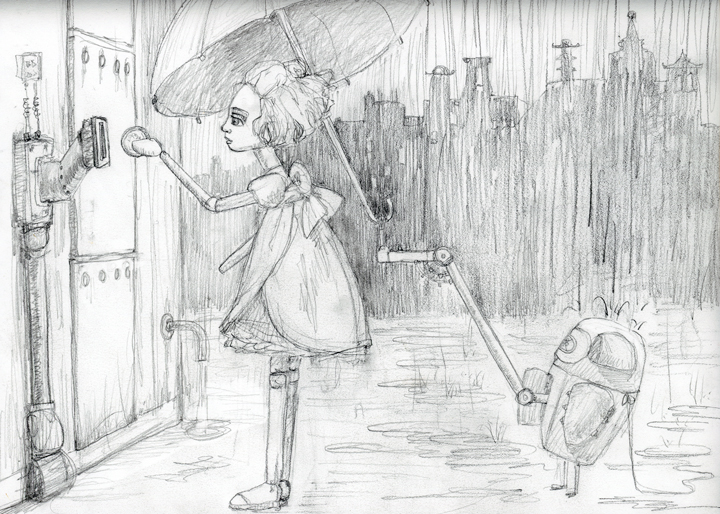
So I decided to play this type of game with my lucid characters I had floating around in my head. I knew I wanted a doll and an owl, but that was where my big idea ended. So I played what I call the “Blind Dictionary” game. This is where you close your eyes and open the dictionary and point. My goal was to find 10 nouns and 10 verbs. Of course I came upon some adjectives and adverbs, but I moved on and didn’t use those. Here were the 10 nouns: (doll and owl I already had), harlequin, thread, hame, factory, kimono, shilling, wheelie, lichen. The 10 verbs were: conspire, spy, twitch, liberate, lick, burn, blow, scoop, retain.Well, I guess that turned out to be only 9, but what resulted was this lush visual material I had now to work with!
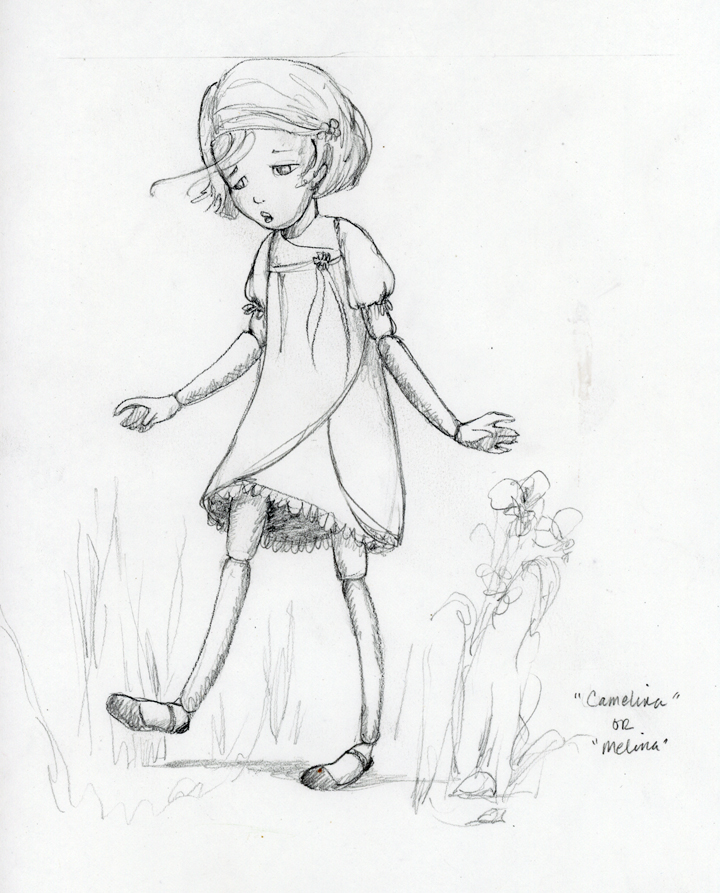
So without further ado, meet Commelina:
and her various transformations:
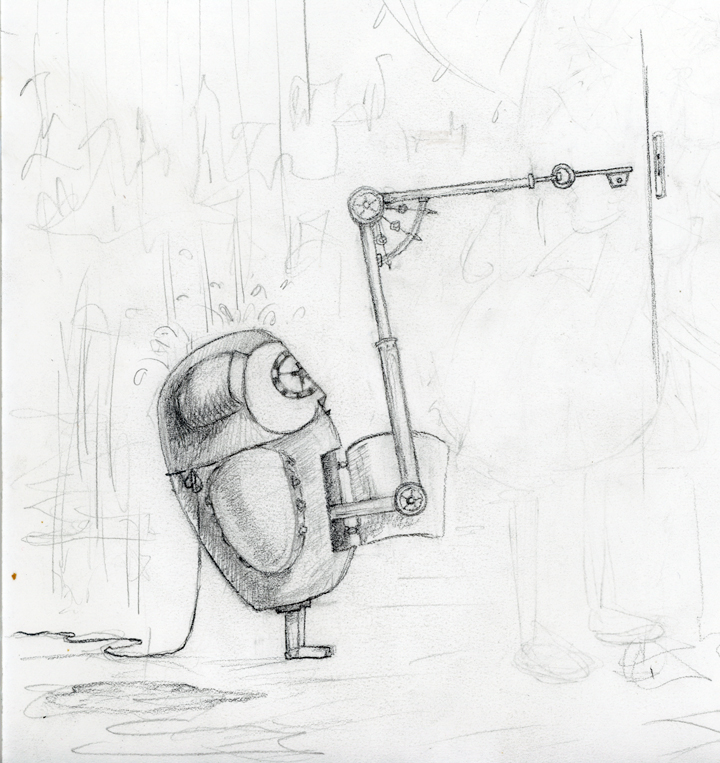
and the clockwork owl, Li:
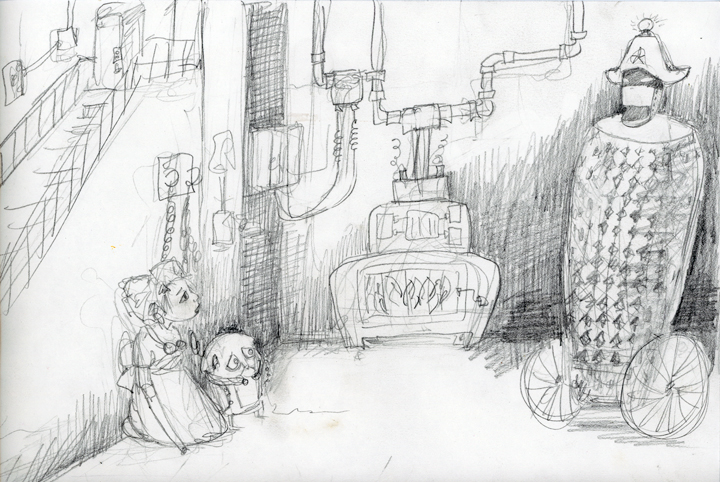
The illustrated plot sequence:
In the end, I realized I may have some stories to tell after all. If the material is not provided for me, there is material out there if I cut and paste it together and make boundaries. Thank you, Priscilla Burris, and once again, thank you SCBWI!
A tip of the day from Art and Fear, by David Bayles and Ted Orland:
“Fears about artmaking fall into two families: fears about yourself, and fears about your reception by others. In a general way, fears about yourself prevent you from doing your best work, while fears about your reception by others prevent you from doing your own work.”
After a little over a month of Petite Paintings I must step back and make sure I’m staying focused on what it is that I do – illustrate stories. While these little daily exercises have helped me get back into traditional material, free up a bit, and are a nice sense of accomplishment, they are not representing that priority. Completely valuable and of course they will continue as planned (365 days!), but I will no longer be posting these exercises on a daily basis. Monthly posts of P3 will occur around the 7-10 of each month (based on the date I started the project). Instead, daily and weekly blogging will focus on illustrating stories, thereby challenging myself further to remember that priority of daily practice in addition to P3. I say this after taking a hard look in the mirror and facing fear about myself and about my reception by others. Thank you, David and Ted.
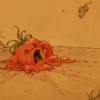
So Moosejaw has asked for 10,352 crying tomatoes, if you’re up to the illustration challenge. Artists of all kinds link up their best crying tomato for Moosejaw rewards points. What’s a crying tomato? Why would a tomato cry? Well, this is my best guess….
Moosejaw challenge (crying tomato)
I’d say that’s a pretty fun way to buy a new tent.
Accountability drives the commitment to blogging daily practice. With accountability, I’m driven to make sure the Petite Painting Project keeps moving forward. After all, it’s OUT THERE, not just in my own world….PUBLIC. So here’s the honest truth: I confess and accept that I am human, and P3 will fall by the wayside from time to time. I have to embrace and accept that as part of this process. This week was one of those times. Plenty of excuses and really, no excuses- just life with two small children, lack of drive and inspiration outside of getting my other commissions accomplished, whatever you want to call it. But I must say, that the week “off” was valuable. It gave me time to just think and look around me (and get over beating myself up a little bit for letting P3 take a back seat). I am beginning to feel energy breathing back into my creative core. So from now on, I won’t shy away from embracing a few days of repose and reflection at the end of each month. After each painting is completed, it gets taped up on my kitchen cabinet doors, so I really live with them. I think I’ll take them down, put them away and start new each month.
I began on August 7, 2012. One month has passed and here’s the look back:
Petite Painting Project, month 1
I’m still searching for the link between these little projects and what it is that I do as an illustrator for children, but also remembering not to have anxiety about it. The answer will come over time. And this is about time and growth. These little paintings are simply a way for me to step outside my usual process and subject matter and look at the world around me. It’s a nice break from coming up with entirely imagined original illustrations. Miniature beauty and sweet compositions lie around me every day. I just have to open my mind to see them.