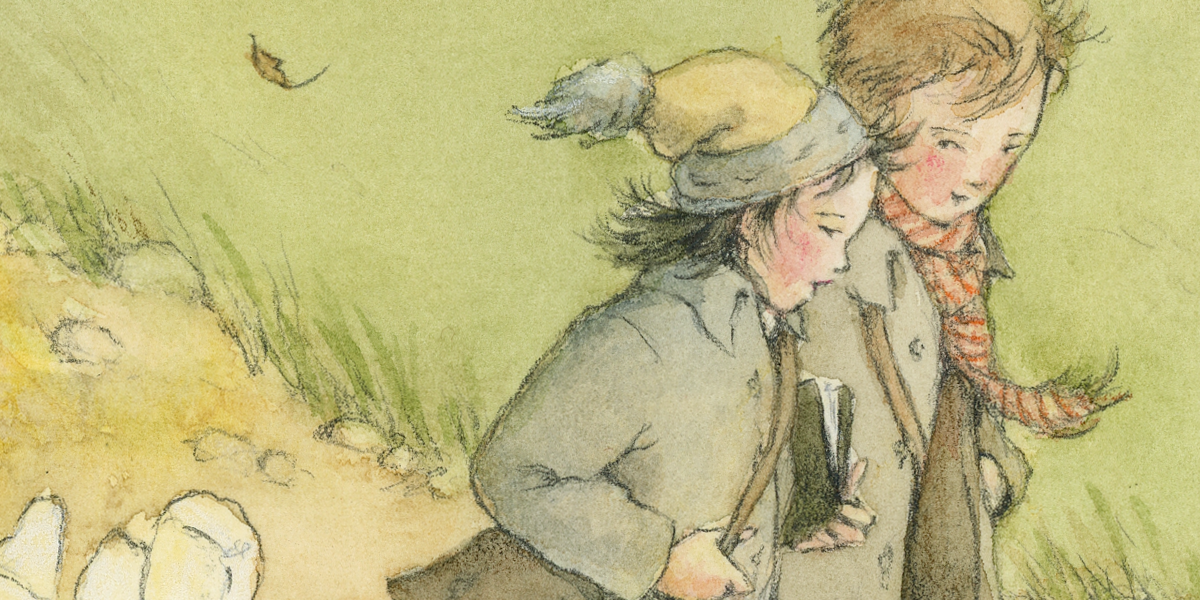
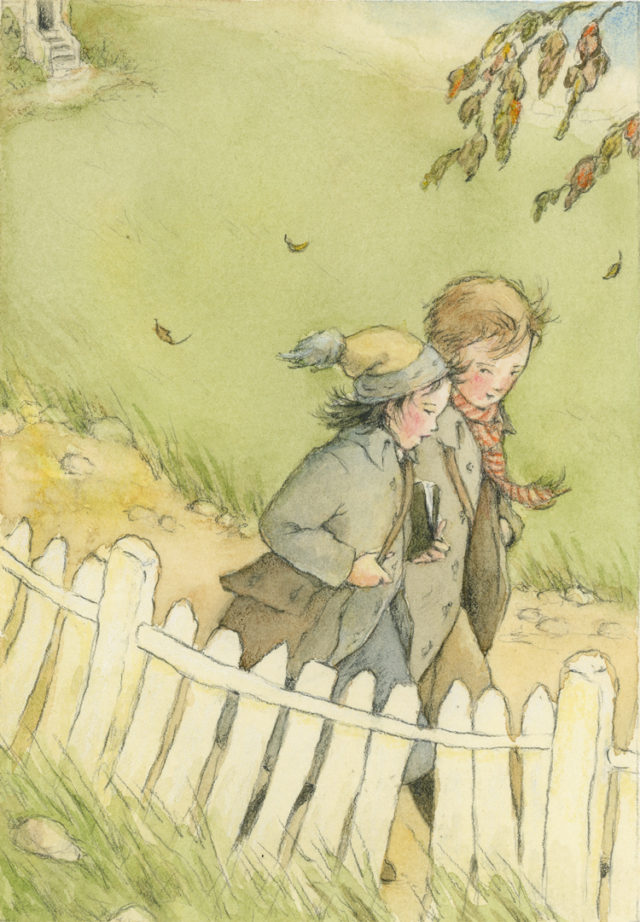
The idea of students walking to school probably brings into mind the old cliché stories of our grandparents – “When I was your age, I used to walk 5 miles to school in the snow!” (That gap between home and school proudly growing larger each time the tale is delivered) We may also regard walking to school as something archaic and “old fashioned” (imagine Laura and Mary Ingles trotting down a sun-dappled dirt path swinging books neatly buckled with a leather strap).
I myself never walked to school. Carpooling in a large station wagon was how my friends and I got around. Then about ten years ago I moved to Greenville to a neighborhood with an elementary school nestled only two blocks away. On the first day of my son’s first grade year, we walked.
We saw a bunny.
We listened to birds.
Watched the way the leaves changed color throughout the year.
We talked to other kids, other parents.
Strangers became friends.
My children are older now, but I still see others buddying up and walking up that hill, their crowns sweetly tilted inward as they talk. I’m confident they will have much better stories to tell about walking to school when they are grandparents.
Happy Earth Day.
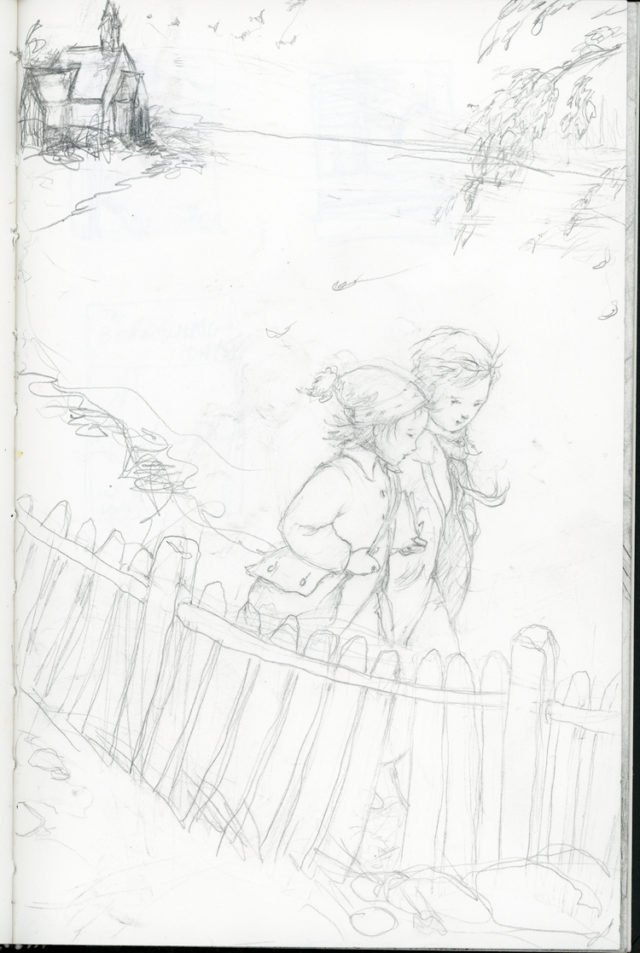
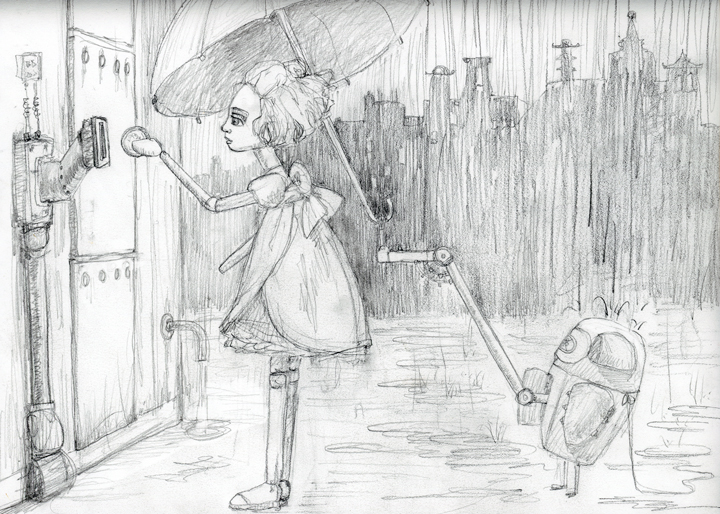
In this painting, I drew inspiration from this life memory….it starts with the sketchbook:
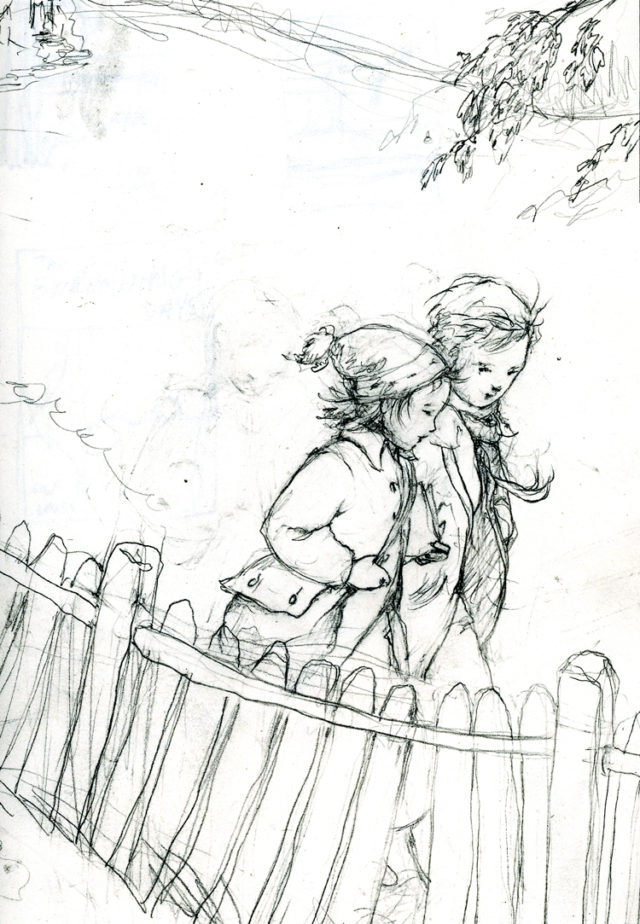
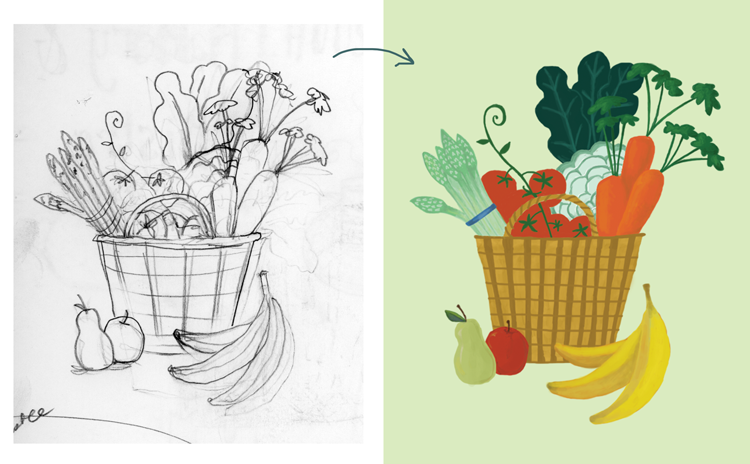
Sketchbook page (Usually worked on in the carpool line of my daughter’s after-school program)The sketch is scanned and cropped, then levels intensified (in Photoshop) for better visibility when transferring. I then print this out.
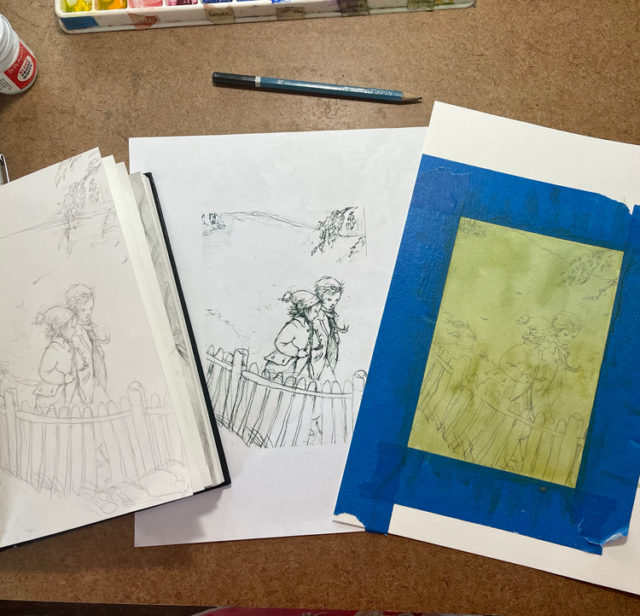
I use an Artograph Light Pad I bought from Michaels (if you pay attention to the coupon savings, you can get these for half the cost!) Place the printed copy of the sketch onto the light pad, and watercolor paper on top. Then trace for a fresh drawing. (Side note: I love listening to podcasts during this phase. One of my very favorites: 99% invisible from Radiotopia. If you haven’t heard of it, carve out 20 minutes today to start enjoying. Hours of discovery awaits you! You can also browse other amazing Radiotopia shows like Criminal, and The Truth)
The art table at a glance…
The process… *note: the watercolor paper washed in green was a first pass/practice on a monochrome surface (I usually keep test washes laying around and draw/paint on top of them for fun) I repeated the process with a clean piece of watercolor paper and added color (see final below)
Then begins the really fun part: bringing it to life with more definition and color….
Check out Elizabeth Bird’s blog post that provides more nice examples of re-illustrated books. She poses the question: “Do any of these improve on the original? Or is re-illustration never really a case of improvement but rather giving kids a variety of different ways to look at something familiar?”
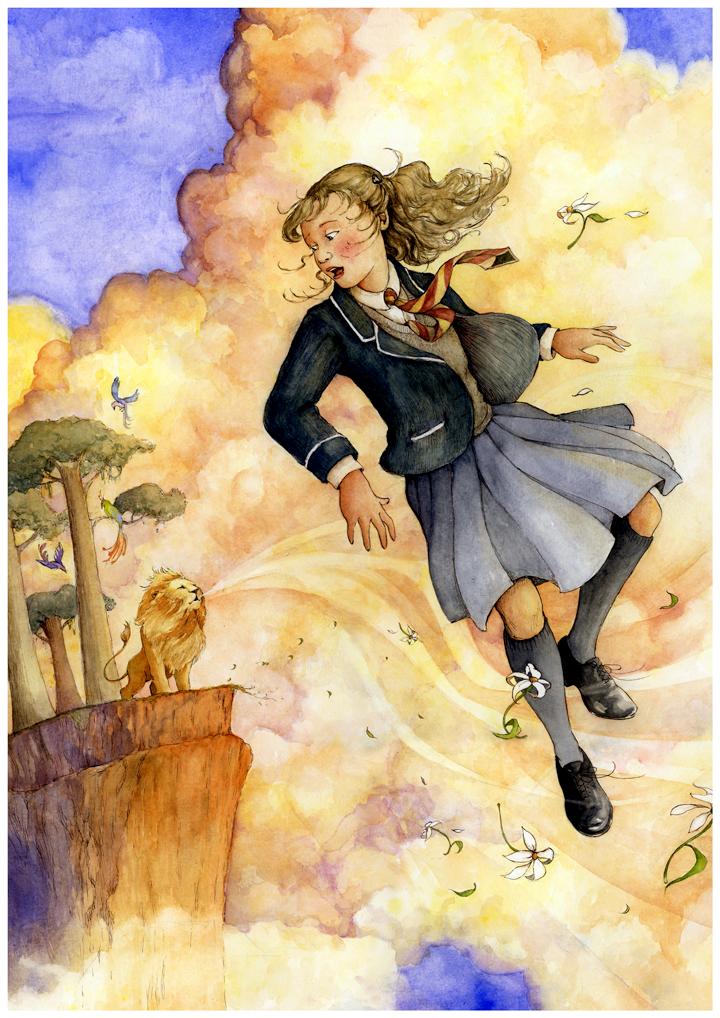
While there are many different views on the subject, the latter is where I choose to stand. I have the highest respect for the magnificent Pauline Baynes, and marvel over her effortless use of lines and loose color washes she added to her original Narnia illustrations. People forever will (and should) honor those drawings as the quintessential benchmark for the world of Narnia. But as an illustrator how can I help myself when I read C.S. Lewis?
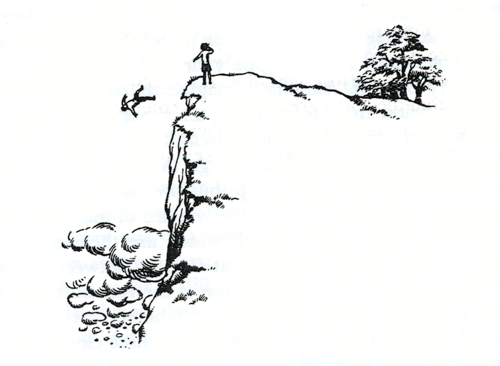
“Stand still. In a moment I will blow. But, first, remember, remember, remember the signs. Say them to yourself when you wake in the morning and when you lie down at night, and when you wake in the middle of the night. And whatever strange things may happen to you, let nothing turn your mind from following the signs. And secondly, I give you a warning. Here on the mountain I have spoken to you clearly: I will not often do so down in Narnia. Here on the mountain, the air is clear and your mind is clear; as you drop down into Narnia, the air will thicken. Take great care that it does not confuse your mind. And the signs which you have learned here will not look at all as you expect them to look, when you meet them there. That is why it is so important to know them by heart and pay no attention to appearances. Remember the signs and believe the signs. Nothing else matters. And now, daughter of Eve, farewell – “ The voice had been growing softer towards the end of this speech and now it faded away altogether. Jill looked behind her. To her astonishment she saw the cliff already more than a hundred yards behind her, and the Lion himself a speck of bright gold on the edge of it. She had been setting her teeth and clenching her fists for a terrible blast of lion’s breath; but the breath had really been so gentle that she had not even noticed the moment at which she left the earth. And now, there was nothing but air for thousands upon thousands of feet below her. – The Silver Chair, chapter 2, The Chronicles of Narnia (C.S. Lewis)
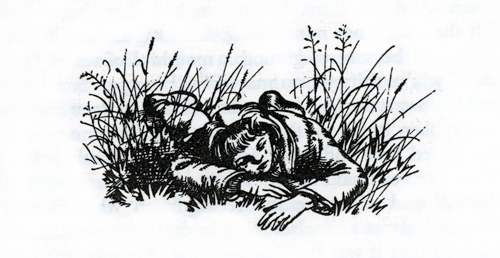
Here are two of Pauline Baynes’ original illustrations surrounding the above scene published in 1953:
Original 1953 illustration by Pauline Baynes The Silver Chair, chapter 1Original 1953 illustration by Pauline Baynes The Silver Chair, chapter 2
In 1998, Ms. Baynes added water-color washes to the original black and white line illustrations for the seven volumes of Narnia:
Baynes’ illustration after her addition of watercolor in 1998 The Silver Chair, chapter 1Baynes’ illustration after her addition of watercolor in 1998 The Silver Chair, chapter 2
And my own interpretation:
Jill is given a Task The Silver Chair, The Chronicles of Narnia (C.S. Lewis) illustration by Alice Ratterree
What are your favorite re-illustrated classics? Are there any classics you would like to see re-imagined?
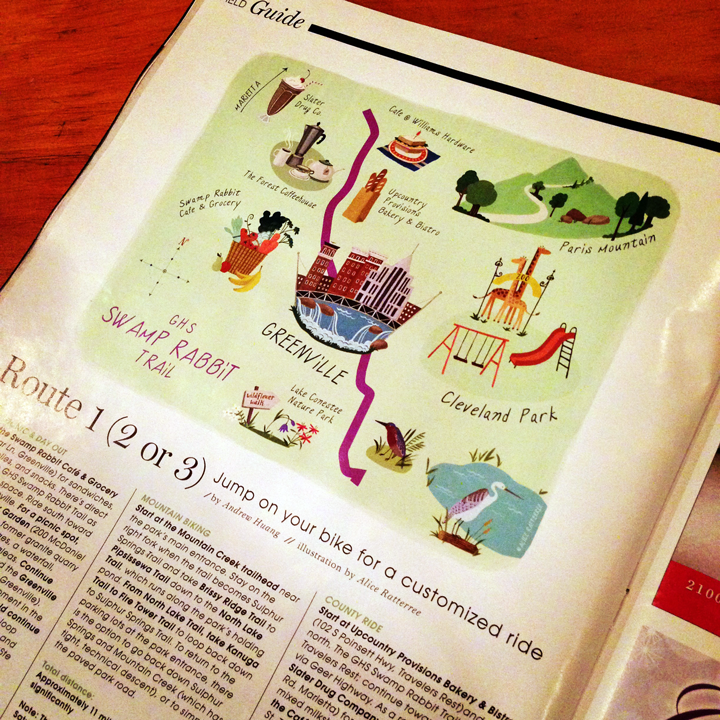
The process, while brand new to me, proved to be very rewarding. It began with a conversation with the editor, in which she provided the key places along the trail that would be highlighted. Initial (messy) notes:
To start, a soft-green base was laid in Photoshop using the paint tools.
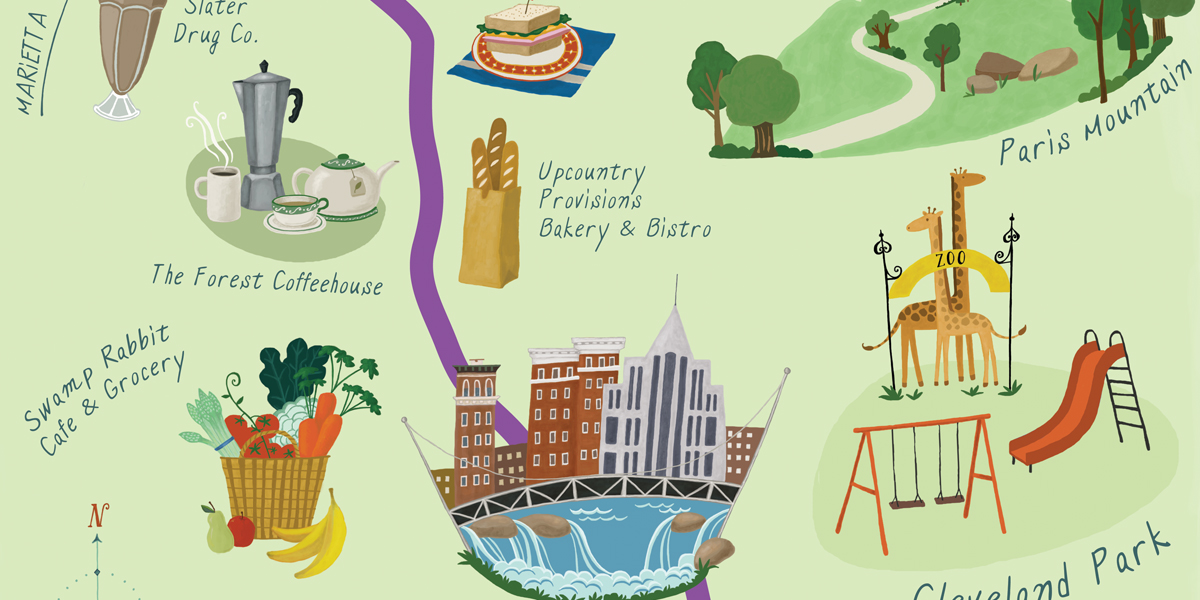
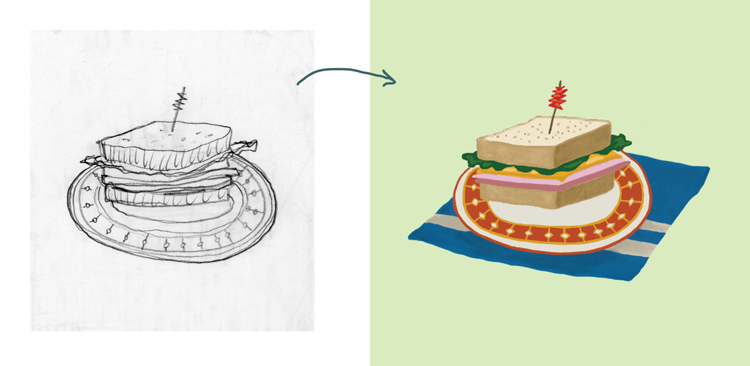
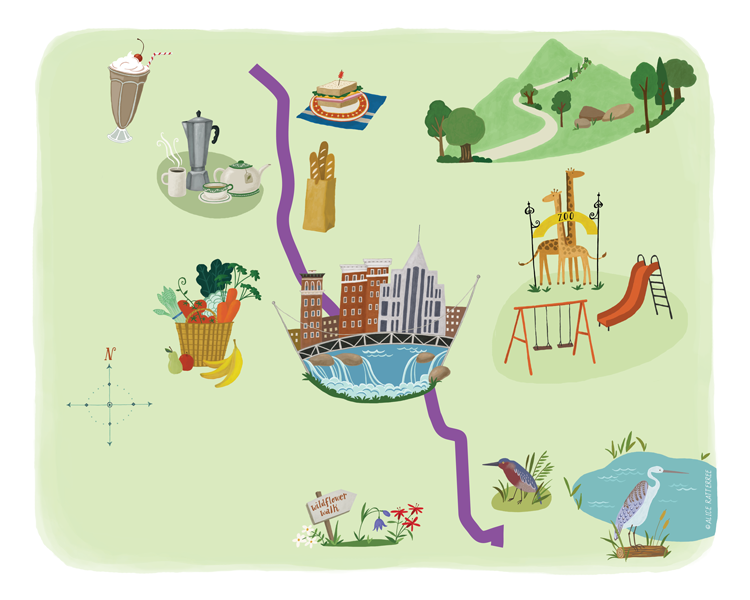
Each location needed a special icon that represented its unique services and attributes. Time is always a constraint with editorial turn around, so I didn’t have the luxury of personally seeing places I wasn’t already familiar with. But it was a lot of fun virtually “visiting” each enterprise’s web site and discovering what it had to offer. I wanted each location’s icon to have a very hand-made look to it, so instead of drawing directly onto the computer, each icon was free-handed (just on plain printer paper- one of my most used and favorite sketching surfaces!) scanned it in, and then traced over it in Photoshop with the paint tool (as a separate layer – that way, the original drawing could be deleted). The result was something like this:
And so on…..
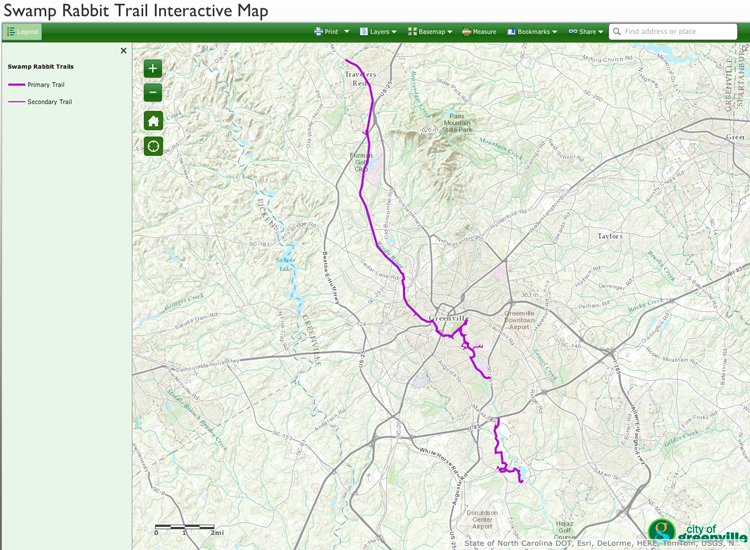
Next task was to add the actual trail. It needed to be accurate, but also a hand-made representation. Thanks to Greenville County Rec‘s interactive map of the trail, the perfect model presented:
I liked the way the bright purple stood out against the earth tones, so I picked a similar bright purple to work against the green foundation I had chosen. The trail had to be simplified somewhat but still have those organic angles. This was traced and simplified in Illustrator then imported as a smart object into Photoshop:
Each icon had been created in its own layer, which allowed me to move them around individually. The interactive map had a feature that allowed me to type in the address of each location and view it in relation to the trail. That gave me the basic vicinity for placement.
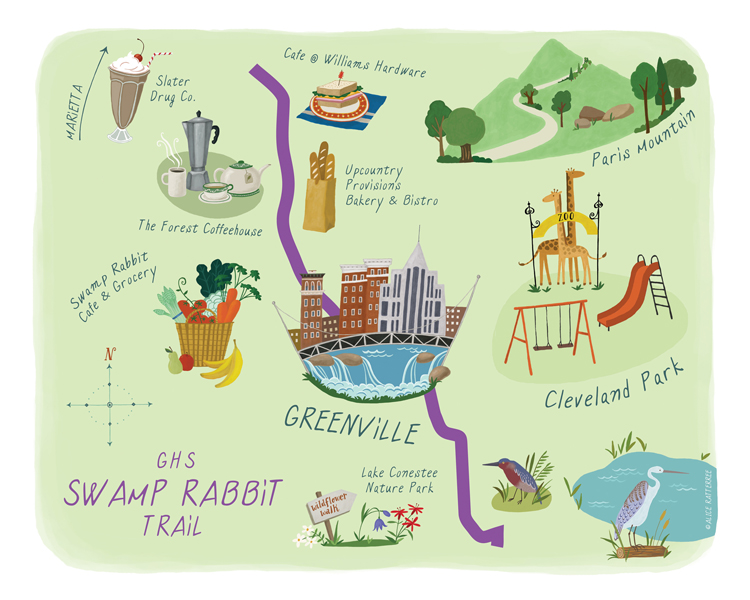
The next layer was choosing typeface. Thanks to MyFonts I chose one that represented the hand-letter quality to work with the image….
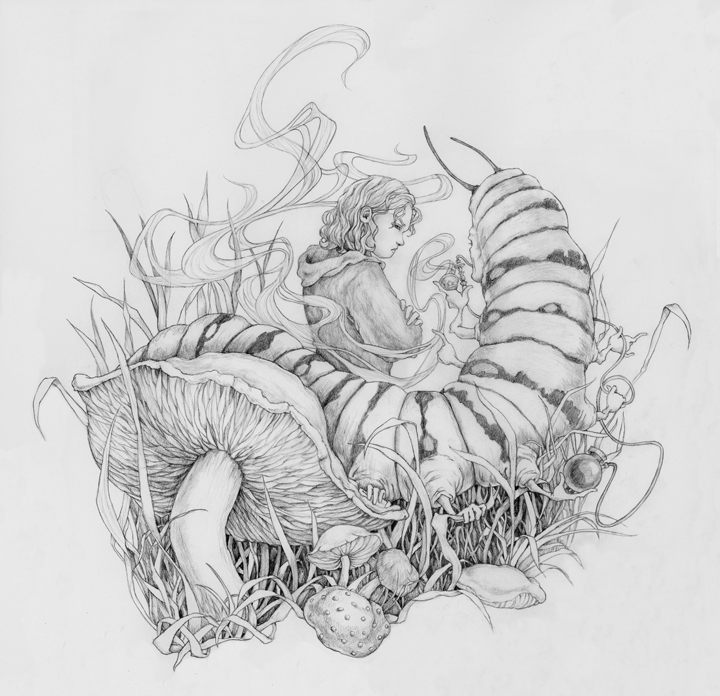
My fascination with Alice continues, this time in her encounter with the caterpillar. He asks her the famous question, “Who are you?” I believe this question is the very heart of Lewis Carroll‘s brilliance. It is his confrontation with Alice’s escapism, as if holding up a mirror to his own character. (Is it a coincidence that the second volume is entitled “Through the Looking Glass and What Alice Found There”?) An interrogative dialogue ensues, leaving Alice flustered, unable to explain herself. Fed up, she tries to leave, embracing escapism again. The caterpillar bids her to return, this time with a command, “Keep you temper.” We don’t blame her for loosing her temper, we identify with Alice. It isn’t easy and is often unpleasant to examine what lies in the mirror.
“Keep Your Temper” – Alice’s Adventures in Wonderland, Lewis Carroll
When we were children, people asked us, “What do you want to be when you grow up?” When we meet someone for the first time, inevitably the question arises, “What do you do?” When we look to higher education, we must ponder what interests us, what talent we harbor, what we want to study. The pattern here? “What,” “What,” and still more “What”… “What?” is a fine and necessary question to consider and define, but it’s the “Who are you?” questions that need our real time and efforts as illustrators. I myself will always be going back to this question, digging for the answers, which needs a life’s work of tending to grow and refine. And in the meantime, I also try to keep my temper.
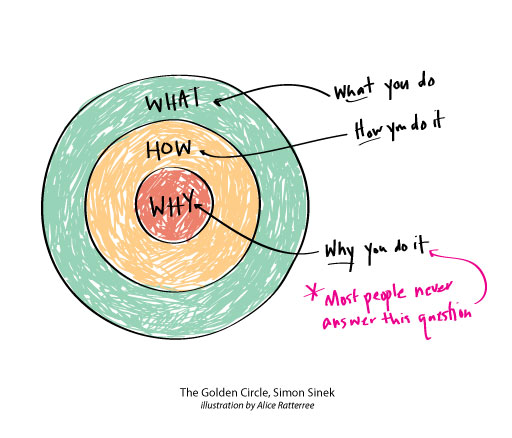
My universe aligned again this week when I attended the annual F.I.R.E. Session hosted by Brains on Fire. The opening talk was given by Jackie Huba, author of the upcoming book, Monster Loyalty: How Lady Gaga Turns Followers into Fanatics. Bet you didn’t think you’d find anything out there that went from Alice in Wonderland to Lady Gaga, but bear with me. I must admit, I’m not a follower of Lady Gaga, and no fanatic, so I can’t officially call myself a “Little Monster” but I do find brilliance in her ability to connect with her fan base, which is what I learned from Jackie this week. And it is in this quest to connect with her fan base, which is value-driven, that Lady Gaga has defined a core group of identity questions, thus enabling her success as an artist. Jackie revealed to us a concept created by Simon Sinek called the Golden Circle that succinctly sums it up:
So here are the three questions, that if well-defined, embody a successful product: What do you do? How do you do it? Why do you do it? Seems simple enough, right? Start trying to really answer these questions about yourself. The “what” is the easy part. It’s your product, plain and simple. So what is Lay Gaga’s “what”? Her “what” is basic: she writes and performs catchy pop songs. But is that really the sum of it all that “Little Monsters” would say when asked “Who is Lady Gaga?” There are plenty of singer/songwriters out there writing and performing catchy pop songs. So what makes her different? The answer lies deeper. Next question: How does Lady Gaga do it? This is what puts her at the top of talking trends today in social media circles. She lives her life as performance art. Think Andy Warhol. Do only the images of his artwork come to mind? No, it is his entire identity. His life style. Go further and you get to the “Why?” Lady Gaga has a platform based on a clear set of values. She is passionate about transforming culture to embrace differences and celebrate individuality, and has created the Born This Way Foundation to promote this value system.
So let’s apply this to illustration work:
WHAT do you do? Illustrate (and for some of us, write also) books for children and youth. This question does not require much introspection and is not highly individualized.
HOW do you do it? This can be defined as your style, ie: the treatment of characters and composition, and the choices that are made in the process. Do you employ realism or are your illustrations whimsical, comic or graphic? Maybe somewhere in between? Are the materials you use an integral part of this unique style? How does this flow into your life style and image? Does social media play a role?
WHY do you do it? This is where it gets purely individual. It is the core, a set of clear values that you harbor and is linked to a larger message you want to impress upon our viewer. Think back to what drove you to pick up that pencil, pen, brush, in the first place. So reflect carefully on the reason you wish to connect with children today and what you want them to see in your work. Because in the end, that is what it is all about. Connecting with our audience – children.
Clear definitive separation of “What” “How” and “Why” is the key. And “Why” is the engine that must fuel and drive the “How” and the “What.” So why do so many of us only stop and focus on “What?” It seems to be a little backwards, right? We start with “What”, then move to “How” then try to fit “Why” in there somewhere. Maybe if we start with “Why” and work outward, then we will finally be able to face that caterpillar when he asks “Who are you?”
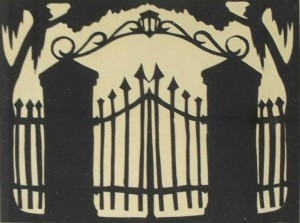
Papercutting is an art form that has been practiced for centuries in many different cultures throughout the world. Being a bit biased, I am particularly drawn to the Southern American heritage of artform of silhouette. A few months ago we discovered this Carew Rice paper cut:
Charleston Gate • Carew Rice • 1933
Rice, a South Carolina native who has been hailed as “America’s Greatest Silhouettist” by the poet Carl Sandberg, was extremely prolific with the medium and brought sophistication and prominence to the technique. The practice derived its name from Eteinne de Silhouette, the French finance minister under Louis XV who imposed high taxes. Since paper-cuts were a more economical way of obtaining a portrait at the time, the business thrived and became a symbol of the economic times, thus forever linking the same “silhouette” with the practice. Silhouettes arrived in America and quickly became the rage in the 18th and 19th century until photography took the forefront. It is now revered for its aesthetic charm and elegant simplicity.
SCBWI‘s annual Tomie dePaola Award is given annually to an SCBWI member illustrator that demonstrates potential and is chosen by Tomie dePaola. The award grants tuition, transportation and accommodations to the New York Winter Conference held in Manhattan, and the winning piece is featured at the annual winter conference in New York.
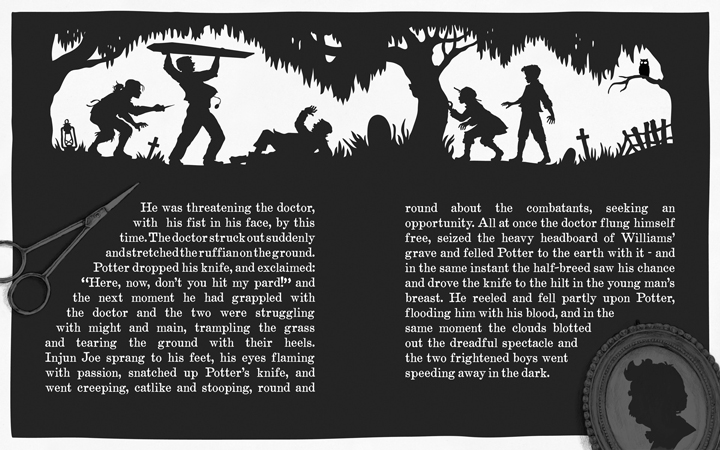
The guidelines for this year’s award were to pick any passage from any one of the following novels: The Adventures of Tom Sawyer (Twain), Little Women (Alcott), The Yearling (Rawlings) The artwork must be in black and white, including half-tones.
This inspired me to pay homage to the southern heritage of paper cutting and the silhouette artform with Mark Twain‘s classic, The Adventures of Tom Sawyer. My intention was to create two narratives. One being a silhouette depiction of the scene, which takes place in chapter 9, and then another on top of that, which is a commentary on the practice of paper cutting depicted by the rendering of the scissors and the framed silhouette portrait of the author. I chose to lay the text in white on top of the black to further intensify the horrific action the boys are witnessing in the graveyard.
Tomie dePaola, reknowned for his books for children, is an illustrator who has been published for over 40 years and has written and/or illustrated nearly 250 books with over 15 million copies of his books sold worldwide. His work and achievements have been recognized with the Smithson Medal from the Smithsonian Institution, the Kerlan Award from the University of Minnesota for his “singular attainment in children’s literature,” and the Regina Medal from the Catholic Library Association. He was also the United States nominee in 1990 for the Hans Christian Andersen Award in illustration. The American Library Association has honored him with a Caldecott Honor Book, a Newbery Honor Book, and the 2011 Laura Ingalls Wilder Award for his “substantial and lasting contribution to literature for children.”
Tomie financially provided the award until 2011 when SCBWI assumed it in recognition of Tomie’s outstanding contribution to SCBWI and to the member illustrators in particular. He has been a member of the Board of Advisors, aided in changing the name of the original organization to include illustrators, founded the Illustrator’s Committee of the SCBWI board, and taught the first master class at an SCBWI conference.
This past weekend, SCBWI Carolinas celebrated their 20th annual conference in Charlotte, NC. I love returning to the well. Inspiring keynotes and energizing breakouts filled our time for three whole days! Illustrators arrived early on Friday for an intensive session with the charming illustrator Priscilla Burris. We were given an assignment ahead of time which was:
Characters Page: Create and develop two characters. Name them.
Main Image: Create and Color Finish an image involving both characters, interacting. (Either one page or 2-pg spread)
Before Image: Create and Sketch an image that shows what happened before the Main Image part of the story.
After Image: Create and Sketch an image that shows what happens after the Main Image part of the story.
Daunting to say the least. No restrictions, not even dimensions. Wide open. I have to admit, when I received this challenge, I was rather disappointed, and frankly had a bad attitude. I wanted something to work with. Please oh please don’t leave me alone in the dark recesses of my shallow creativity to make something completely original! I felt like I was suddenly being asked to write, and I wanted to illustrate! Sadly, I realized that I’ve been relying on someone else’s work to propel me into my work. How was I going to start with a completely blank canvas?
The answer was in creating boundaries. I’ve heard it said that if children are playing in a large field with no fence, they will gather together in a tight radius near the middle and not venture out very far from each other, playing within a very limited space. If, however they are provided a fenced in perimeter, they will utilize all the space for play. I read that Dr. Seuss had only a 225 word list with which to work from in writing Cat in the Hat. Boundaries propel us into creative thinking by forcing us to solve problems. Last year at the convention, writer John Bemis left us with a most inspiring keynote that provided some tools to work with when we are faced with creative blocks. We were all asked to write 20 words, then step back and look at them. What did they say? Where was the common thread? Is there any imagery that comes to mind? Next he shared with us a game that included asking a question, then find a picture (from a magazine or a book). The last step is to connect your question with the image you found. How does the image you found answer your question?
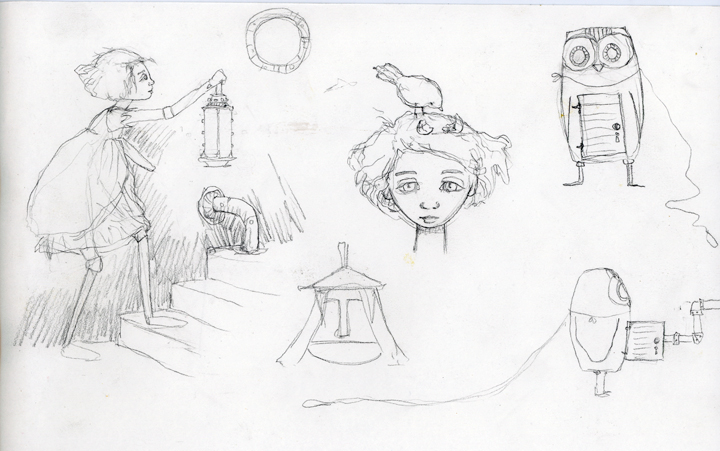
So I decided to play this type of game with my lucid characters I had floating around in my head. I knew I wanted a doll and an owl, but that was where my big idea ended. So I played what I call the “Blind Dictionary” game. This is where you close your eyes and open the dictionary and point. My goal was to find 10 nouns and 10 verbs. Of course I came upon some adjectives and adverbs, but I moved on and didn’t use those. Here were the 10 nouns: (doll and owl I already had), harlequin, thread, hame, factory, kimono, shilling, wheelie, lichen. The 10 verbs were: conspire, spy, twitch, liberate, lick, burn, blow, scoop, retain.Well, I guess that turned out to be only 9, but what resulted was this lush visual material I had now to work with!
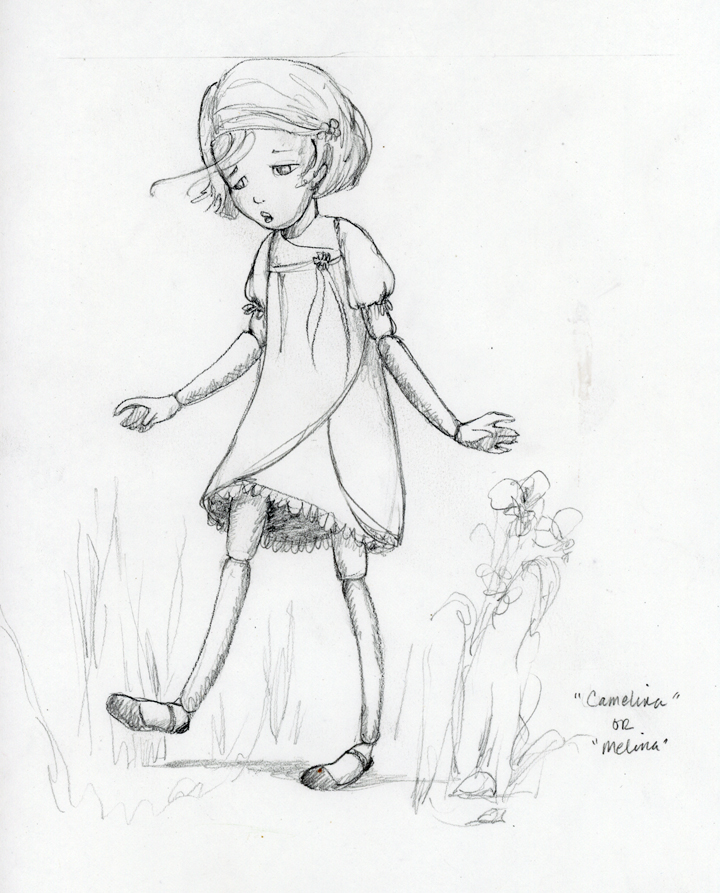
So without further ado, meet Commelina:
and her various transformations:
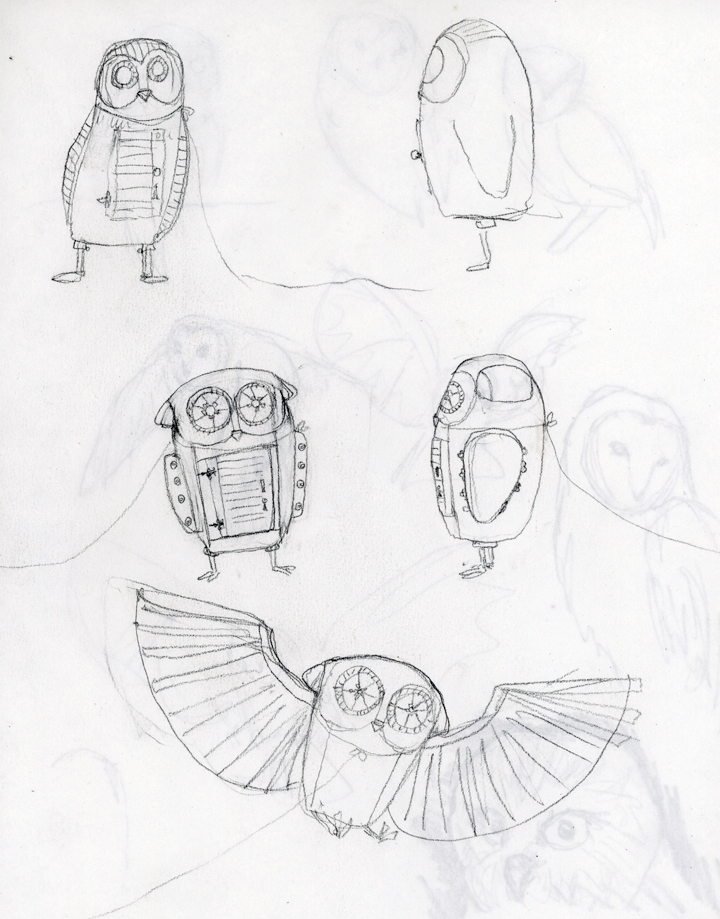
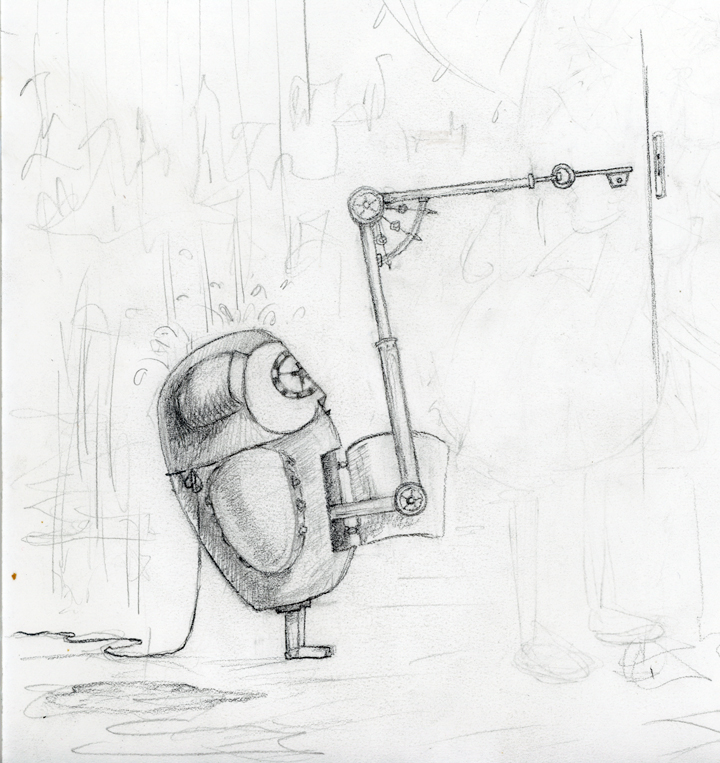
and the clockwork owl, Li:
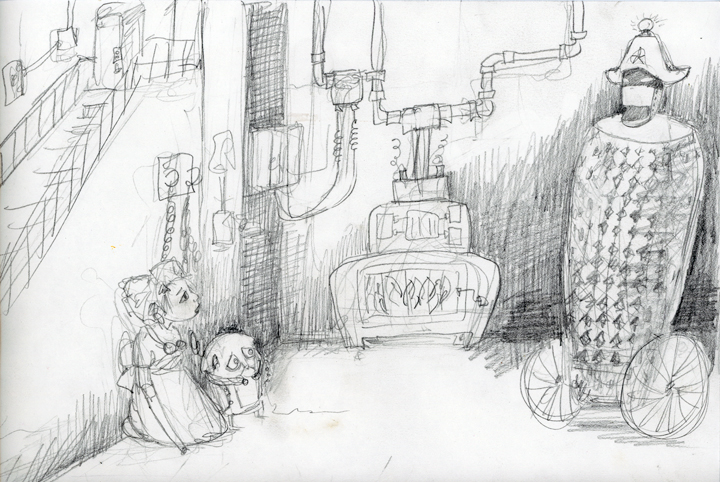
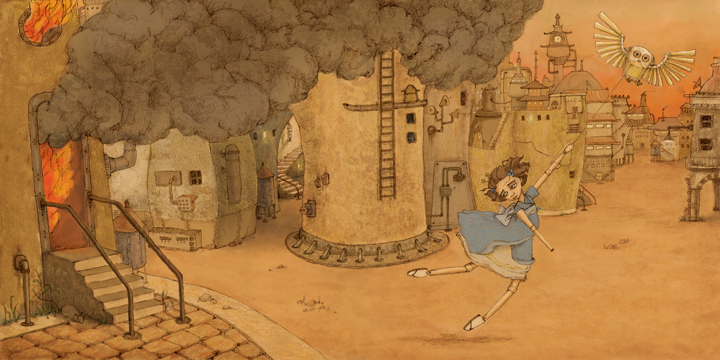
The illustrated plot sequence:
In the end, I realized I may have some stories to tell after all. If the material is not provided for me, there is material out there if I cut and paste it together and make boundaries. Thank you, Priscilla Burris, and once again, thank you SCBWI!
A tip of the day from Art and Fear, by David Bayles and Ted Orland:
“Fears about artmaking fall into two families: fears about yourself, and fears about your reception by others. In a general way, fears about yourself prevent you from doing your best work, while fears about your reception by others prevent you from doing your own work.”
After a little over a month of Petite Paintings I must step back and make sure I’m staying focused on what it is that I do – illustrate stories. While these little daily exercises have helped me get back into traditional material, free up a bit, and are a nice sense of accomplishment, they are not representing that priority. Completely valuable and of course they will continue as planned (365 days!), but I will no longer be posting these exercises on a daily basis. Monthly posts of P3 will occur around the 7-10 of each month (based on the date I started the project). Instead, daily and weekly blogging will focus on illustrating stories, thereby challenging myself further to remember that priority of daily practice in addition to P3. I say this after taking a hard look in the mirror and facing fear about myself and about my reception by others. Thank you, David and Ted.
So Moosejaw has asked for 10,352 crying tomatoes, if you’re up to the illustration challenge. Artists of all kinds link up their best crying tomato for Moosejaw rewards points. What’s a crying tomato? Why would a tomato cry? Well, this is my best guess….
Moosejaw challenge (crying tomato)
I’d say that’s a pretty fun way to buy a new tent.
So I’m working on a collaborative book for the Upstate Book Project (http://bit.ly/o5sKpQ) The first page was given by Chuck Bailie (http://bit.ly/4Vx70o) and then sent in progession to 19 other artists/writers. I’m page 13. By the time I received it, Graycie (the main character who lives in a world void of color) had just freed a hoard of cats from a world of color by way of a broken mirror in her bedroom. So I’ve been drawing cats. Cats. And more cats. And you know what? Cats are pretty expressive and fascinating creatures to illustrate. Who knew? I usually shy away from animals and am drawn towards people. If it hadn’t been for this project, I know I wouldn’t have spent a week drawing cats. Thanks, Upstate Book Project, for reminding me to venture outside of my comfort zone.
Above image is the pencil draft of page 13….with 8 cats!